
2828 results
OCT. 15, 2026 / AI
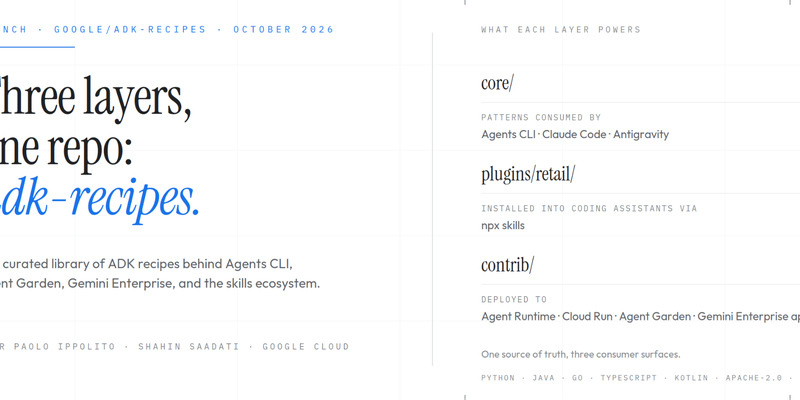
The google/adk-recipes repository unifies Agent Development Kit (ADK) resources into three structured layers—core/, plugins/, and contrib/—serving as a single source of truth for building AI agents. Developers can leverage reference patterns, install modular vertical skills (such as retail product search and virtual try-on) directly into their coding assistants, and deploy production-ready services across multiple languages. This cohesive structure streamlines the entire workflow from initial scaffolding to full deployment on Google Cloud infrastructure.
OCT. 15, 2026 / Mobile
Google OAuth Platform now supports DPoP (Demonstrating Proof-of-Possession) to sender-constrain refresh tokens, neutralizing Infostealer malware and adversary-in-the-middle attacks. By cryptographically binding long-lived refresh tokens while maintaining short-lived access tokens as standard Bearer tokens, developers achieve robust credential security without incurring high-QPS API performance overhead. Additionally, developers integrating multi-agent or Model Context Protocol (MCP) workloads can use Google Cloud Secure Token Service (STS) to handle secure token delegation across agent chains.

OCT. 15, 2026 / AI
A practical engineering guide and reference architecture for establishing continuous evaluation pipelines for multi-turn AI agents using Gemini Enterprise Agent Platform, Google ADK, and OpenInference standards.

OCT. 14, 2026 / AI
Apigee hybrid 1.17.0 introduces native Model Context Protocol (MCP) support, enabling the MCP data plane to run directly within your own Kubernetes cluster. This architecture ensures that AI agent request traffic and tool execution remain entirely inside your infrastructure while pulling configuration updates from the control plane. Developers can expose OpenAPI 3.0.x specifications as discoverable MCP tools, leverage existing security policies and API products, and trace end-to-end requests using W3C trace context headers.

OCT. 13, 2026 / Gemini
How our engineering team ran Gemini 4 Argon unattended overnight with .agents/skills and /goal mode to cut in-memory session prep overhead by 40% in long sessions and speed up cold imports by 21% in Google's open-source Python Agent Development Kit (ADK).

OCT. 13, 2026 / AI
Gemini 4 Argon is a general-purpose physical reasoning model designed to enhance workflows across the robotics stack with advanced capabilities in physical understanding, code generation, and visual-semantic reasoning. Developers can access and integrate Argon across Google's developer platforms—including Google AI Studio, the Gemini API, and Google Antigravity—to build and test sophisticated robotic applications. By leveraging simulation tools like MuJoCo and code-as-policies, engineers can seamlessly transition from real-world data or sketches to physically verified robot control and self-improvement workflows.

OCT. 8, 2026 / AI
How do you keep improving an AI agent after the first 80%, once it serves real production traffic and silent quality regressions return HTTP 200 OK? We are open-sourcing AQuA (Ambient Quality Agent), a reference implementation that runs beside your production agent in Google Cloud, sweeps and verifies failure clusters against conversation transcripts, and diagnoses root causes anchored to the exact deployed source snapshot.

OCT. 8, 2026 / Mobile
Google AI Edge has introduced ML Drift, a high-performance, universal GPU compute framework designed to accelerate on-device AI and machine learning inference. By abstracting the complexities of hardware and low-level APIs—including OpenGL ES, OpenCL, Metal, and WebGPU—ML Drift enables developers to build real-time, interactive ML experiences, from sophisticated video effects to generative AI, across mobile and desktop platforms.

OCT. 7, 2026 / AI
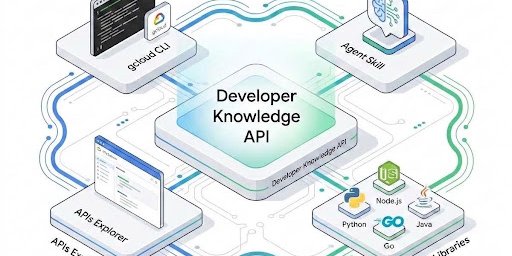
Google is launching the Developer Knowledge API and MCP Server in public preview. This new toolset provides a canonical, machine-readable way for AI assistants and agentic platforms to search and retrieve up-to-date documentation across Firebase, Google Cloud, Android, and more. By using the official MCP server, developers can connect tools directly to Google’s documentation corpus, ensuring that AI-generated code and guidance are based on authoritative, real-time context.
OCT. 6, 2026 / Mobile
EmbeddingGemma 2 is a new 740M open-weight multimodal model that maps text, images, video, and audio into a unified vector space for privacy-first, on-device retrieval. Developers can easily integrate these capabilities cross-platform using MediaPipe Tasks or optimize fine-grained performance across CPU, GPU, and NPU accelerators with LiteRT. The model enables ultra-low-latency local solutions like search-as-you-type media retrieval, keyframe video moments finding, and zero-shot intent routing.
