The landscape of AI development is shifting from stateless request-response cycles to stateful, multi-turn agentic workflows. With the beta launch of the Interactions API, Google is providing a unified interface designed specifically for this new era—offering a single gateway to both raw models and the fully managed Gemini Deep Research Agent.
For developers already working with the Agent Development Kit (ADK) and the Agent2Agent (A2A) protocol, this raises an exciting question: How does this new API fit into my existing ecosystem?
The answer is two-fold. The Interactions API acts as both an alternative to the existing generateContent inference API endpoint and as a powerful primitive you can use within an existing agent framework.
In this post, we’ll explore two primary patterns for integration:
When you build an agent using the ADK (Agent Development Kit), you need a LLM like Gemini which generates the thoughts, plans, tool calls and responses. Previously, this was handled by generateContent.
The new Interactions API offers a native interface for complex state management. By upgrading your inference calls to use this new endpoint, your ADK agents gain access to capabilities designed specifically for agentic loops.
model=”gemini-3-pro-preview”) or a built-in Gemini agent (agent=”deep-research-pro-preview-12-2025”).previous_interaction_id, reducing the boilerplate code in your ADK agent.background=True, the API immediately returns an interaction ID and offloads the reasoning loop to the server. This allows the client to disconnect without hitting timeouts and asynchronously poll the endpoint to retrieve the final output.Instead of managing a raw list of messages and sending them to generateContent, your ADK agent can maintain a lighter-weight pointer to the server-side state.
from google.adk.agents.llm_agent import Agent
from google.adk.models.google_llm import Gemini
from google.adk.tools.google_search_tool import GoogleSearchTool

root_agent = Agent(
    model=Gemini(
        model="gemini-2.5-flash",
        # Enable Interactions API
        use_interactions_api=True,
    ),
    name="interactions_test_agent",
    tools=[
        # Converted Google Search to a function tool
        GoogleSearchTool(bypass_multi_tools_limit=True),
        get_current_weather,
    ],
)For step by step instructions see the full ADK sample with the Interactions API.
This pattern allows you to keep the control flow and routing logic within the ADK while delegating the heavy lifting of context management and inference state to the Interactions API.
We often describe an inner loop (inside the API) and an outer loop (in your agent code), and this new API gives you more control over both.
This is where the interoperability of the Agent2Agent (A2A) protocol shines.
If you have an existing ecosystem of A2A clients or agents, you might want them to consult the new Gemini Deep Research Agent. Historically, integrating a new third-party API would require writing a custom wrapper or adapter.
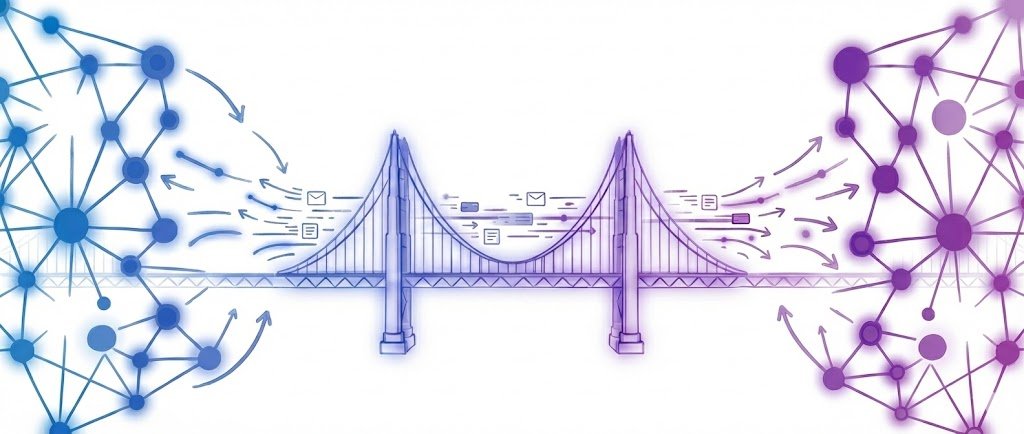
With the new InteractionsApiTransport, we have mapped the A2A protocol surface directly onto the Interactions API surface. It “speaks” A2A. This means you can treat an Interactions API endpoint as just another remote A2A agent. Your existing clients don't need to know they are talking to a Google-hosted agent; they just see an AgentCard and send messages as usual.
The InteractionsApiTransport layer performs a translation to A2A:
SendMessage → Interactions createTask → Interaction IDTaskStatus → Interaction Status (e.g., IN_PROGRESS maps to TASK_STATE_WORKING)Note: A2A push notifications, A2A extensions, and Interactions API callbacks are not yet supported in this mapping.
To use this,simply configure your A2A client factory with the new transport and create a card that points to the model or agent you want to use.
from interactions_api_transport import InteractionsApiTransport
from a2a.client import ClientFactory, ClientConfig

# 1. Configure the factory to support Interactions API
client_config = ClientConfig()
client_factory = ClientFactory(client_config)

# Setup the transport (handles API keys and auth transparently)
InteractionsApiTransport.setup(client_factory)

# 2. Create an AgentCard for the Deep Research agent
# This helper method constructs the card with the necessary 'smuggled' config
card = InteractionsApiTransport.make_card(
    url="https://generativelanguage.googleapis.com",
    agent="deep-research-pro-preview-12-2025"
)

# 2a. You can also interact directly with a Gemini model
card = InteractionsApiTransport.make_card(
    url="https://generativelanguage.googleapis.com",
    model="gemini-3-pro-preview",
    request_opts={
        "generation_config": { "thinking_summaries": "auto" }
    }
)

# 3. Create a regular A2A client
client = client_factory.create(card)

# 4. Use it exactly like any other A2A agent
async for event in client.send_message(new_text_message("Research the history of Google TPUs")):
    # The transport converts Interactions API 'Thoughts' and 'Content'
    # into standard A2A Task events.
print(event)This approach makes the Interactions API "transparent" to your developer experience. You gain immediate access to powerful new tools like Deep Research without refactoring your multi-agent system.
And the best part, it just works.
thinking_summaries) inside the AgentCard without breaking the standard protocol.The Gemini Interactions API represents a major step forward in how we model AI communication. Whether you are building custom agents from scratch using any framework like the ADK or connecting existing agents together via A2A, this is a new set of capabilities to start exploring today.
By treating the API as both a superior inference engine and a compliant remote agent, you can rapidly expand the capabilities of your agentic mesh with minimal friction. Expect many more ADK and A2A resources over the next few weeks to help developers adopt this new API.