106 results
JULY 21, 2026 / AI
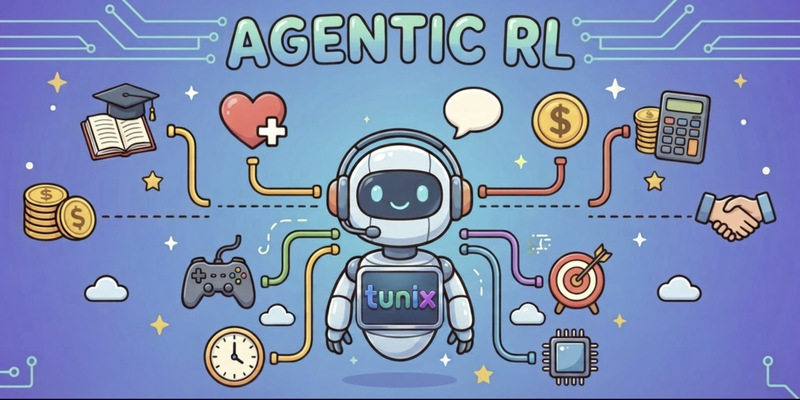
Tunix is Google’s new JAX-native post-training library designed to eliminate TPU idling bottlenecks when training multi-turn, tool-using LLM reasoning agents. It maximizes hardware throughput by combining highly concurrent, asynchronous rollouts with a decoupled producer-consumer pipeline, ensuring the trainer is constantly fed even while agents wait on network I/O or environment steps. Additionally, Tunix provides plug-and-play abstractions and continuous macro-level profiling, allowing developers to easily integrate custom open-source environments and optimize complex distributed workflows without massive code rewrites.
JULY 16, 2026 / AI
Google Cloud has partnered with Parallel Web Systems to natively integrate Parallel's search infrastructure as a web grounding provider on the Gemini Enterprise Agent Platform. This integration enables developers to anchor their AI agents in verifiable, real-time web results, significantly improving factual accuracy for complex enterprise workflows. Additionally, the partnership offers expanded architectural flexibility, allowing users to programmatically extract, permanently cache, and process web data alongside other large language models.

JULY 16, 2026 / AI
To resolve the scaling bottlenecks and runtime errors caused by monolithic system prompts, engineering teams should treat prompts as build artifacts by modularizing instructions into reusable templates. By running these modular "skill files" through a transpiler, developers can enforce static validation, catch missing dependencies at build time, and integrate prompt generation directly into their CI/CD pipelines. This deterministic approach prevents code drift and ultimately establishes a safe framework where agents can propose updates to their own logic via standard pull requests.
JULY 8, 2026 / Mobile
On May 23, 2026, fresh off the stage at Google I/O, our Google Developer Experts (GDEs) converged on...

JULY 1, 2026 / AI
The open-source Genkit framework has introduced the Agents API, a full-stack tool designed to simplify the complex plumbing of conversational AI by packaging message history, tool loops, and streaming into a single interface. The API supports flexible, server- or client-managed state persistence—allowing for advanced workflows like history branching, long-running detached tasks, and multi-agent coordination—while seamlessly connecting backends to frontends via a unified wire protocol. Currently available in preview for TypeScript and Go, it also integrates with the Genkit Developer UI to allow developers to easily test, debug, and inspect agent snapshots without writing client code.
JULY 1, 2026 / AI
Answering the questions of "why we built ADK 2.0". This explains the rationale, some of the features, and why a developer should consider upgrading. This will be published the day after ADK go 2.0 launches.

JUNE 22, 2026 / AI
How a Python agent and a Go agent collaborate on contract compliance using the Agent2Agent protocolY...

JUNE 22, 2026 / Web
AI coding agents are rapidly shifting from reactive assistants that complete tasks when prompted to ...

JUNE 18, 2026 / AI
Celebrating the first anniversary of the Agent-to-Agent (A2A) protocol, this blog post highlights how the framework enables autonomous AI agents to securely collaborate and hand off tasks without the rigidity of traditional APIs. By delegating complex workflows to specialized peer agents, A2A prevents context pollution, ensures data privacy, and simplifies application design through modularity. To demonstrate this ecosystem in action, the post spotlights FoldRun—an agentic interface for life sciences that orchestrates complex protein structure predictions—alongside diverse A2A use cases spanning commerce, data streaming, DevOps, and telecommunications.

JUNE 17, 2026 / Web
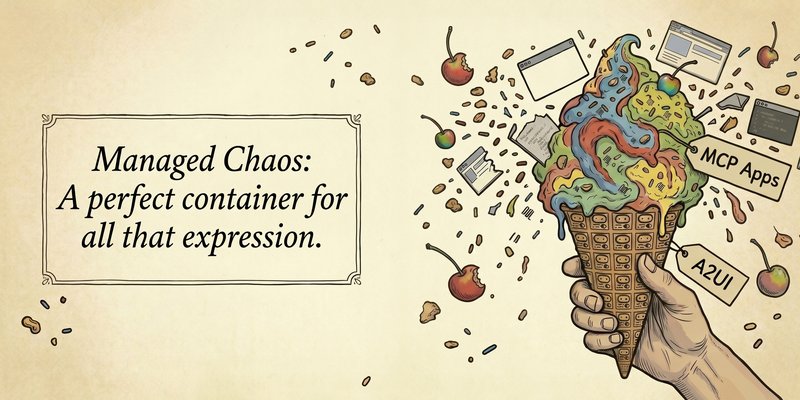
This post introduces three architectural patterns designed to integrate Model Context Protocol (MCP) Apps and Agent-to-User Interface (A2UI) to solve the tradeoff between highly custom iframe environments and native, declarative rendering. By combining these approaches, developers can serve native-feeling UIs directly over MCP servers, embed complex and stateful iframe apps securely inside declarative views, or inject generative UI components into legacy systems. Ultimately, these hybrid frameworks empower engineering teams to deliver secure, performant, and brand-consistent agentic user experiences tailored to their specific project constraints.