
26 results
MAY 21, 2026
ADK for Kotlin brings agentic workflows to your backend projects, while ADK for Android provides spe...
MAY 12, 2026 / AI
How to transition from stateless chatbots to production-grade agents capable of managing long-running enterprise workflows, such as HR onboarding, that span days or weeks. It introduces the Agent Development Kit (ADK) and its architectural shifts, specifically using durable state machines and persistent session storage to ensure an agent never loses context during "idle time" or server restarts. By leveraging event-driven webhooks and multi-agent delegation, the tutorial demonstrates how to build resilient systems that "sleep" during pauses and wake up to resume complex tasks with high reasoning accuracy.

APRIL 21, 2026 / AI
The blog post outlines the transition of a brittle sales research prototype into a robust production agent using Google’s Agent Development Kit (ADK). By replacing monolithic scripts with orchestrated sub-agents and structured Pydantic outputs, the developers eliminated silent failures and fragile parsing. Additionally, the post highlights the necessity of dynamic RAG pipelines and OpenTelemetry observability to ensure AI agents are scalable, cost-effective, and transparent in real-world applications.

APRIL 14, 2026 / AI
The Google Cloud AI Agent Bake-Off highlights a shift from simple prompt engineering to rigorous agentic engineering, emphasizing that production-ready AI requires a modular, multi-agent architecture. The post outlines five key developer tips, including decomposing complex tasks into specialized sub-agents and using deterministic code for execution to prevent probabilistic errors. Furthermore, it advises developers to prioritize multimodality and open-source protocols like MCP to ensure agents are scalable, integrated, and future-proof against rapidly evolving model capabilities.

APRIL 1, 2026 / AI
The Agent Development Kit (ADK) SkillToolset introduces a "progressive disclosure" architecture that allows AI agents to load domain expertise on demand, reducing token usage by up to 90% compared to traditional monolithic prompts. Through four distinct patterns—ranging from simple inline checklists to "skill factories" where agents write their own code—the system enables agents to dynamically expand their capabilities at runtime using the universal agentskills.io specification. This modular approach ensures that complex instructions and external resources are only accessed when relevant, creating a scalable and self-extending framework for modern AI development.

MARCH 31, 2026 / AI
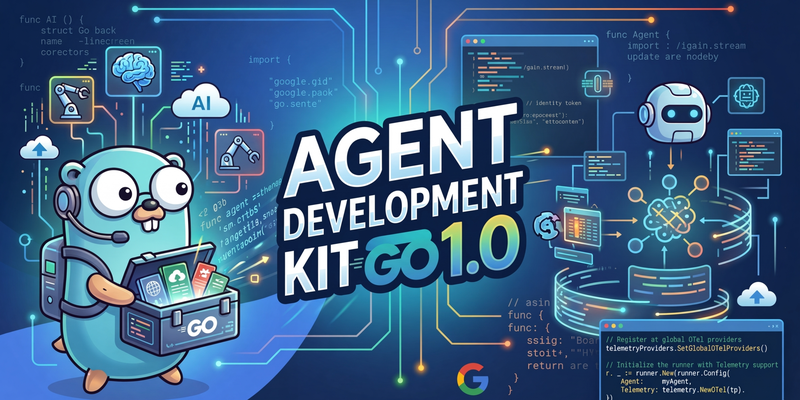
The launch of Agent Development Kit (ADK) for Go 1.0 marks a significant shift from experimental AI scripts to production-ready services by prioritizing observability, security, and extensibility. Key updates include native OpenTelemetry integration for deep tracing, a new plugin system for self-healing logic, and "Human-in-the-Loop" confirmations to ensure safety during sensitive operations. Additionally, the release introduces YAML-based configurations for rapid iteration and refined Agent2Agent (A2A) protocols to support seamless communication across different programming languages. This framework empowers developers to build complex, reliable multi-agent systems using the high-performance engineering standards of Golang.
MARCH 30, 2026 / AI
Google has released version 1.0.0 of the Agent Development Kit (ADK) for Java, introducing powerful new features like Google Maps grounding, built-in URL fetching, and a standardized Agent2Agent protocol for cross-framework collaboration. The update enhances agent control through a new "App" and "Plugin" architecture, which allows for global logging, automated context window management via event compaction, and "Human-in-the-Loop" workflows for action confirmations. Additionally, the release provides robust session and memory services using Google Cloud integrations like Firestore and Vertex AI to manage long-term state and large data artifacts.
MARCH 18, 2026 / AI
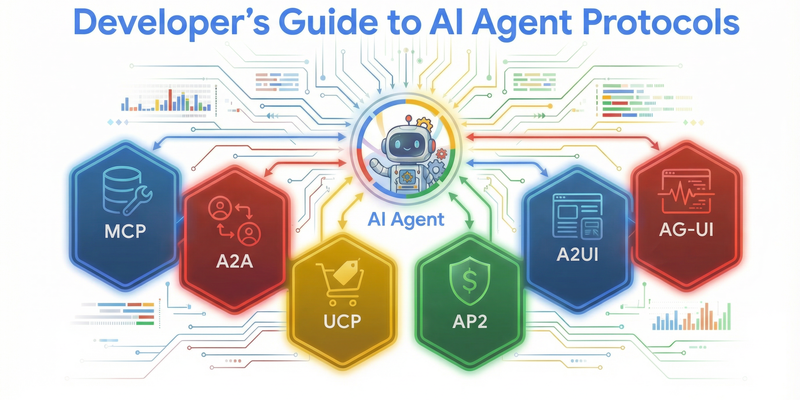
This blog post introduces a suite of six protocols, such as MCP and A2A, designed to eliminate custom integration code by standardizing how AI agents access data and communicate. Using a "kitchen manager" agent as a practical example, it demonstrates how these tools handle complex tasks like real-time inventory checks, wholesale commerce via UCP, and secure payment authorization through AP2. By leveraging the Agent Development Kit (ADK), developers can also implement A2UI and AG-UI to deliver interactive dashboards and seamless streaming interfaces to users.
MARCH 9, 2026 / Cloud
Wednesday Build Hour is a weekly, interactive "technical gym session" led by Google Cloud experts to help developers and architects sharpen their cloud skills. Moving beyond passive slide decks, the program focuses on hands-on building, covering advanced topics like AI agents, Vertex AI, and developer productivity tools. Each hour-long session is designed to provide tangible results that participants can immediately deploy into their own workflows. It serves as a consistent, dedicated space for builders to stay ahead of the curve and connect with a community of cloud engineers.
FEB. 27, 2026 / AI
Agent Development Kit (ADK) now supports a robust ecosystem of third-party tools and integrations. Connect your agents to GitHub, Notion, Hugging Face, and more to build capable, real-world applications.
