131 results
APRIL 29, 2026 / Cloud
Google Cloud has introduced a high-performance integration that connects Rapid Storage directly to PyTorch via the fsspec interface to eliminate AI training bottlenecks. By utilizing Google’s Colossus architecture and bidirectional gRPC streaming, the solution offers up to 15 TiB/s aggregate throughput and significant reductions in latency. These improvements allow developers to speed up total training time by 23% with zero code changes required beyond updating the storage bucket type.

MARCH 31, 2026 / AI
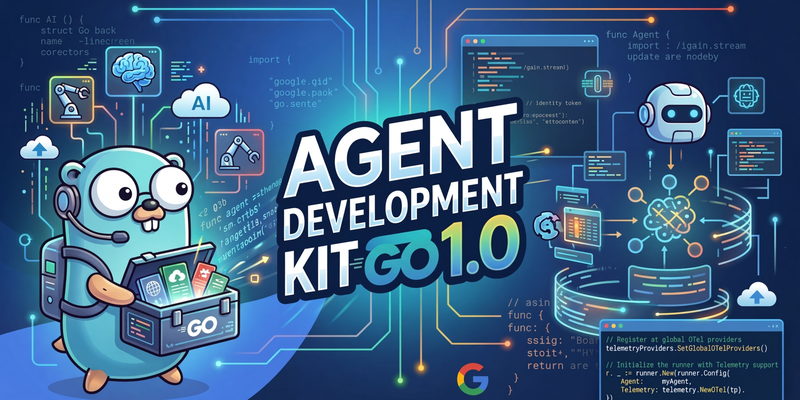
The launch of Agent Development Kit (ADK) for Go 1.0 marks a significant shift from experimental AI scripts to production-ready services by prioritizing observability, security, and extensibility. Key updates include native OpenTelemetry integration for deep tracing, a new plugin system for self-healing logic, and "Human-in-the-Loop" confirmations to ensure safety during sensitive operations. Additionally, the release introduces YAML-based configurations for rapid iteration and refined Agent2Agent (A2A) protocols to support seamless communication across different programming languages. This framework empowers developers to build complex, reliable multi-agent systems using the high-performance engineering standards of Golang.
MARCH 25, 2026 / AI
To bridge the gap between static model knowledge and rapidly evolving software practices, Google DeepMind developed a "Gemini API developer skill" that provides agents with live documentation and SDK guidance. Evaluation results show a massive performance boost, with the gemini-3.1-pro-preview model jumping from a 28.2% to a 96.6% success rate when equipped with the skill. This lightweight approach demonstrates how giving models strong reasoning capabilities and access to a "source of truth" can effectively eliminate outdated coding patterns.
MARCH 24, 2026 / Mobile
The provided workflow streamlines motion-controlled game development by using Gemini Canvas to rapidly prototype mechanics like the MediaPipe Pose Landmarker through high-level prompting. Developers can refine these prototypes in Google AI Studio by optimizing for low-latency "lite" models and stable tracking points, such as shoulder landmarks, to ensure responsive gameplay. The process concludes by using Gemini Code Assist to refactor experimental code into a modular, production-ready application capable of supporting various multimodal inputs.

MARCH 6, 2026 / Cloud
Google has officially launched LiteRT, the successor to TFLite, which offers significantly faster GPU and NPU acceleration alongside seamless support for PyTorch and JAX. The update also introduces lower-precision data type support for increased efficiency and a commitment to more frequent security and dependency updates across the TensorFlow ecosystem. This transition solidifies LiteRT as Google's primary high-performance framework for deploying GenAI and advanced on-device inference.

FEB. 27, 2026 / AI
Agent Development Kit (ADK) now supports a robust ecosystem of third-party tools and integrations. Connect your agents to GitHub, Notion, Hugging Face, and more to build capable, real-world applications.

FEB. 3, 2026 / AI
Finetuning the FunctionGemma model is made fast and easy using the lightweight JAX-based Tunix library on Google TPUs, a process demonstrated here using LoRA for supervised finetuning. This approach delivers significant accuracy improvements with high TPU efficiency, culminating in a model ready for deployment.
JAN. 28, 2026 / Mobile
LiteRT, the evolution of TFLite, is now the universal framework for on-device AI. It delivers up to 1.4x faster GPU, new NPU support, and streamlined GenAI deployment for models like Gemma.
DEC. 8, 2025 / Mobile
LiteRT and MediaTek are announcing the new LiteRT NeuroPilot Accelerator. This is a ground-up successor for the TFLite NeuroPilot delegate, bringing seamless deployment experience, state-of-the-art LLM support, and advanced performance to millions of devices worldwide.
DEC. 4, 2025 / AI
ADK introduces **Context Engineering** to scale AI agents beyond large context windows. It treats context as a compiled view over a tiered, stateful system (**Session, Memory, Artifacts**). This architecture uses explicit processors for transformation, enables efficient compaction and caching, and allows for strict, scoped context handoffs in multi-agent workflows to ensure reliability and cost-effectiveness in production.