

If you've built with AI agents, you know the pain of treating them like simple, stateless tools. True agents need to be conversational and dynamic, but to unlock their real potential, they need a common language to collaborate and hand off tasks securely. That was our vision exactly one year ago when we launched the Agent-to-Agent (A2A) protocol. Today, as we celebrate A2A's 1st birthday, the vision of a collaborative agentic ecosystem is becoming a reality—and it's growing faster than you think.
Before we look at A2A in action, it's important to understand why we need a new protocol. Why not just connect agents via standard REST APIs?
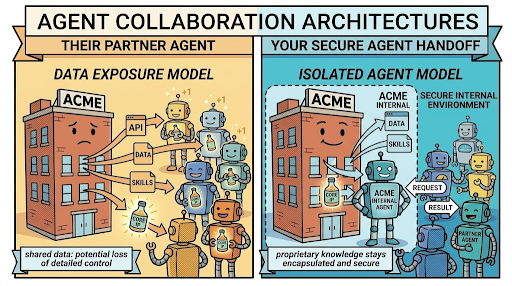
APIs are rigid and deterministic; agents are fluid and autonomous. Treating an agent like an API severely limits its potential. The A2A protocol was designed specifically for the era of generative AI, offering several critical architectural advantages:
To see this architecture in action, we need to look no further than life sciences. Predicting a protein's 3D structure is the "Holy Grail" of biology, but for a developer, it's an infrastructure nightmare. Between petabyte-scale genetic databases, specialized GPU requirements, and the multi-step lifecycle of models like AlphaFold, OpenFold, and Boltz, recreating this functionality from scratch is a massive "complexity cliff."
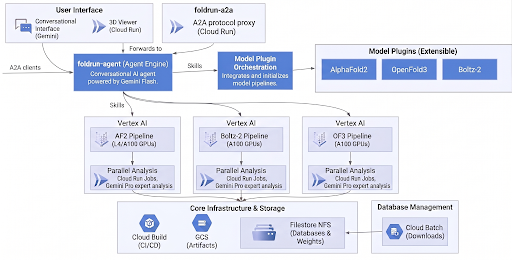
Foldrun isn't just a tool or a script; it is a standalone, agentic interface.
In the old world, you'd have to pipe together a fragile workflow of APIs, or build your own agent, inject specialized skills, secure the environment, and hope you didn't break anything. In the A2A world, you simply add the Foldrun agent to Gemini Enterprise, the Gemini CLI, or any A2A-compliant environment.
Foldrun manages the long-running, autonomous tasks that require dynamic decision-making—like adjusting parameters based on prediction confidence and choosing between AlphaFold 2, OpenFold 3, or Boltz-2 depending on the molecule. You ask for the work, assign the task, and Foldrun delivers the output as a specialized peer.
Foldrun at home Quick-Start To see Foldrun in action within an A2A workflow:
Developer Pro-Tip: Use the Gemini CLI to "hand off" a protein sequence to Foldrun. Gemini CLI supports any A2A agent, including Foldrun. While it handles the heavy lifting of the 3D modeling, your primary agent remains free to manage the rest of your research pipeline.
“To ensure FoldRun meets the complex demands of real-world environments, we partnered closely with BicycleTx as a core design partner. Their team has been actively evaluating the solution, providing crucial feedback that has directly shaped the feature's development.
"We’ve been looking at ways of getting the power of co-folding models into the hands of our scientists from various teams. Having a solution that allows them to do this with an agentic interface, one which our organization is embracing through Gemini Enterprise, has made testing and integration with workflows much easier,"
— Richard Hughes, BicycleTx
By exploring FoldRun within their processes, BicycleTx is unlocking new ways to optimize workflows and scale their agent-driven operations. We are incredibly grateful for their ongoing partnership and are excited to bring these capabilities to the broader community soon.”
If A2A can orchestrate petabyte-scale biological modeling, what else can it unlock? By standardizing how agents communicate, we are seeing incredible innovation across every sector of the industry:
The easiest way to join the ecosystem is through our official SDKs. Whether you are building from scratch or extending the spec, the path to interoperability has never been clearer.
It’s our 1st Birthday, but you get the gifts. We want to see what you’ve built!


