62 results
OCT. 13, 2026 / AI
Gemini 4 Argon is a general-purpose physical reasoning model designed to enhance workflows across the robotics stack with advanced capabilities in physical understanding, code generation, and visual-semantic reasoning. Developers can access and integrate Argon across Google's developer platforms—including Google AI Studio, the Gemini API, and Google Antigravity—to build and test sophisticated robotic applications. By leveraging simulation tools like MuJoCo and code-as-policies, engineers can seamlessly transition from real-world data or sketches to physically verified robot control and self-improvement workflows.

OCT. 13, 2026 / Gemini
How our engineering team ran Gemini 4 Argon unattended overnight with .agents/skills and /goal mode to cut in-memory session prep overhead by 40% in long sessions and speed up cold imports by 21% in Google's open-source Python Agent Development Kit (ADK).

OCT. 8, 2026 / Mobile
Google AI Edge has introduced ML Drift, a high-performance, universal GPU compute framework designed to accelerate on-device AI and machine learning inference. By abstracting the complexities of hardware and low-level APIs—including OpenGL ES, OpenCL, Metal, and WebGPU—ML Drift enables developers to build real-time, interactive ML experiences, from sophisticated video effects to generative AI, across mobile and desktop platforms.

OCT. 7, 2026 / AI
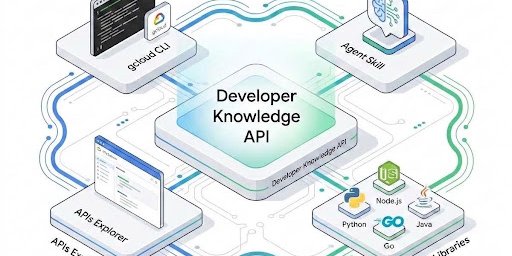
Google is launching the Developer Knowledge API and MCP Server in public preview. This new toolset provides a canonical, machine-readable way for AI assistants and agentic platforms to search and retrieve up-to-date documentation across Firebase, Google Cloud, Android, and more. By using the official MCP server, developers can connect tools directly to Google’s documentation corpus, ensuring that AI-generated code and guidance are based on authoritative, real-time context.
OCT. 6, 2026 / Mobile
EmbeddingGemma 2 is a new 740M open-weight multimodal model that maps text, images, video, and audio into a unified vector space for privacy-first, on-device retrieval. Developers can easily integrate these capabilities cross-platform using MediaPipe Tasks or optimize fine-grained performance across CPU, GPU, and NPU accelerators with LiteRT. The model enables ultra-low-latency local solutions like search-as-you-type media retrieval, keyframe video moments finding, and zero-shot intent routing.

OCT. 6, 2026 / AI
EmbeddingGemma 2 is a compact, open-source multimodal embedding model that maps text, code, images, video, and audio into a unified 768-dimensional space. Developers can use the sentence-transformers library to selectively load modular modality encoders—ranging from 270M to 740M parameters—to optimize memory usage. Additionally, Matryoshka Representation Learning enables dynamic dimension truncation down to 128d, significantly reducing vector database storage requirements while maintaining high retrieval performance.
SEPT. 30, 2026 / AI
To address the quadratic latency bottleneck of self-attention in high-resolution video diffusion models, developers implemented Sparse VideoGen (SVG) to dynamically route attention heads to highly structured spatial or temporal sparse masks. Translating this algorithmic sparsity into physical hardware speedups on TPUs required optimizing the Splash Attention kernel by bypassing empty memory tiles, restricting exact coordinate masking strictly to boundary tiles, and permuting token memory layouts into temporal-major order for contiguous access. By aligning these sparse masks with actual hardware tile execution, the combined optimizations significantly reduced wasted matrix operations and achieved up to a 1.69x end-to-end inference speedup for 1440p video generation.

SEPT. 24, 2026 / AI
The MaxText team successfully reproduced Ai2’s Olmo 3 7B language model from scratch on Google Cloud TPUs using JAX/XLA, precisely matching the original PyTorch-on-GPU reference across pre-training and mid-training stages on all held-out evaluations. The implementation achieved up to 57.4% Model Flops Utilization (MFU) and demonstrated robust infrastructure portability by surviving mid-run cluster resizes and cross-generation TPU shifts without requiring recipe alterations. Crucially, the exercise proved the necessity of comprehensive held-out validation by catching a silent data-loader memorization bug that artificially depressed training loss and would have otherwise faked a performance win.

SEPT. 17, 2026 / AI
Google has partnered with Speakeasy to open-source their OpenAPI code generation suite under the AGPLv3 license, a strategic move prompted by the sudden shutdown of Google's previous proprietary SDK provider. The newly open-sourced suite equips developers with deterministic, multi-language SDK generators that natively support strict typing and SSE streaming, alongside tools for compiling agent-native CLIs and documentation MCP servers. Engineering teams can now safely integrate this robust tooling directly into their CI pipelines to automatically generate reliable client libraries for their own APIs, all while retaining complete licensing control over the output code.
SEPT. 16, 2026 / AI
Agent Anomaly Detection is a new, out-of-band oversight layer for the Gemini Enterprise Agent Platform that analyzes OpenTelemetry traces and tool calls to catch behavioral risks without adding runtime latency to live requests. It utilizes a multi-tiered detection pipeline—combining lightweight statistical scanning with deep LLM-based reasoning—to identify logical anomalies and policy violations grounded in the OWASP Agentic Top 10. Developers can triage these automated findings within Security Command Center or leverage the exposed API to programmatically block subsequent tool calls when an agent breaches defined risk thresholds.