171 results
SEPT. 30, 2025 / AI
Tunix is a new JAX-native, open-source library for LLM post-training. It offers comprehensive tools for aligning models at scale, including SFT, preference tuning (DPO), advanced RL methods (PPO, GRPO, GSPO), and knowledge distillation. Designed for TPUs and seamless JAX integration, Tunix emphasizes developer control and shows a 12% relative improvement in pass@1 accuracy on GSM8K.
SEPT. 26, 2025 / AI
Grounding with Google Maps in Vertex AI is now generally available, helping developers build factual and reliable generative AI applications connected to real-world, up-to-date information from Google Maps. This unlocks better, more personal results and is useful across industries like travel, real estate, devices, and social media.

SEPT. 26, 2025 / AI
The ADK and AG-UI integration enables developers to build interactive AI applications by combining a powerful backend (ADK) with a flexible frontend protocol (AG-UI). This unlocks features like Generative UI, Shared State, Human-in-the-Loop, and Frontend Tools, allowing for seamless collaboration between AI and human users.

SEPT. 25, 2025 / AI
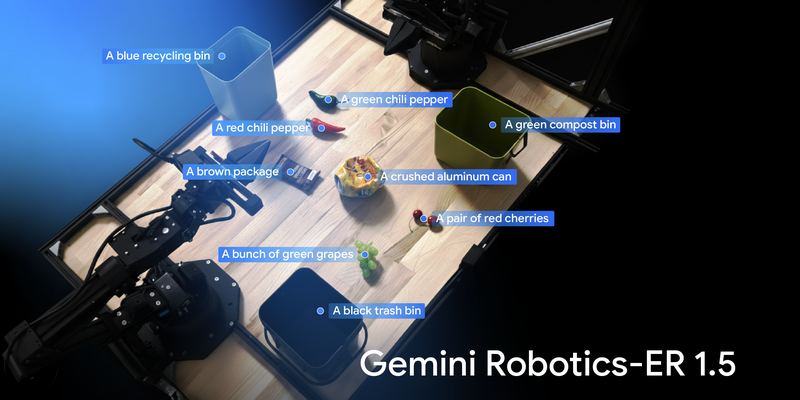
Gemini Robotics-ER 1.5, now available to developers, is a state-of-the-art embodied reasoning model for robots. It excels in visual, spatial understanding, task planning, and progress estimation, allowing robots to perform complex, multi-step tasks.
SEPT. 24, 2025 / Mobile
Google AI Edge provides the tools to run AI features on-device, and its new LiteRT-LM runtime is a significant leap forward for generative AI. LiteRT-LM is an open-source C++ API, cross-platform compatibility, and hardware acceleration designed to efficiently run large language models like Gemma and Gemini Nano across a vast range of hardware. Its key innovation is a flexible, modular architecture that can scale to power complex, multi-task features in Chrome and Chromebook Plus, while also being lean enough for resource-constrained devices like the Pixel Watch. This versatility is already enabling a new wave of on-device generative AI, bringing capabilities like WebAI and smart replies to users.

SEPT. 16, 2025 / AI
The Agent Development Kit (ADK) for Java 0.2.0 now integrates with LangChain4j, expanding LLM support to include third-party and local models like Gemma and Qwen. This release also enhances tooling with instance-based FunctionTools, improved async support, better loop control, and advanced agent logic with chained callbacks and new memory management.
SEPT. 10, 2025 / AI
We are launching 1.0 stable release of Genkit Go, empowering Go developers to build performant, production-ready AI-powered applications with Genkit. Recent enhancements include support for integrating and building MCP tools, expanding third-party model provider support, and production AI monitoring with Firebase. Additionally, we are announcing a new feature in the Genkit CLI to provide AI development tools, like the Gemini CLI and Cursor, with the latest knowledge of Genkit - supercharging Genkit development experience when using AI assistance.
SEPT. 9, 2025 / Mobile
Google AI Edge has expanded the Gemma 3n preview to include audio support. Users can play with it on their own mobile phone using the Google AI Edge Gallery, which is now available in Open Beta on Play Store.

SEPT. 9, 2025 / AI
JAX, a framework known for large-scale AI model development, is proving to be a powerful tool in scientific computing, particularly for solving complex Partial Differential Equations (PDEs), now being leveraged by researchers to achieve significant speed-ups and memory reductions in solving high-order PDEs and demonstrating its potential to unlock new frontiers in scientific discovery.
SEPT. 4, 2025 / AI
Learn how to use Google's EmbeddingGemma, an efficient open model, with Google Cloud's Dataflow and vector databases like AlloyDB to build scalable, real-time knowledge ingestion pipelines.