69 results
MAY 12, 2026 / AI
How to transition from stateless chatbots to production-grade agents capable of managing long-running enterprise workflows, such as HR onboarding, that span days or weeks. It introduces the Agent Development Kit (ADK) and its architectural shifts, specifically using durable state machines and persistent session storage to ensure an agent never loses context during "idle time" or server restarts. By leveraging event-driven webhooks and multi-agent delegation, the tutorial demonstrates how to build resilient systems that "sleep" during pauses and wake up to resume complex tasks with high reasoning accuracy.

MAY 4, 2026 / AI
Researchers at UCSD have successfully implemented DFlash, a block-diffusion speculative decoding method, on Google TPUs to bypass the sequential bottlenecks of traditional autoregressive drafting. By "painting" entire blocks of candidate tokens in a single forward pass rather than predicting them one-by-one, the system achieved average speedups of 3.13x, with peak performance nearly doubling that of existing methods like EAGLE-3. This open-source integration into the vLLM ecosystem optimizes TPU hardware by leveraging "free" parallel verification and high-quality draft predictions for complex reasoning tasks.

APRIL 15, 2026 / AI
Gemini CLI has introduced subagents, specialized expert agents that handle complex or high-volume tasks in isolated context windows to keep the primary session fast and focused. These agents can be customized via Markdown files, run in parallel to boost productivity, and are easily invoked using the @agent syntax for targeted delegation. This architecture prevents "context rot" by consolidating intricate multi-step executions into concise summaries for the main orchestrator.

APRIL 2, 2026 / Mobile
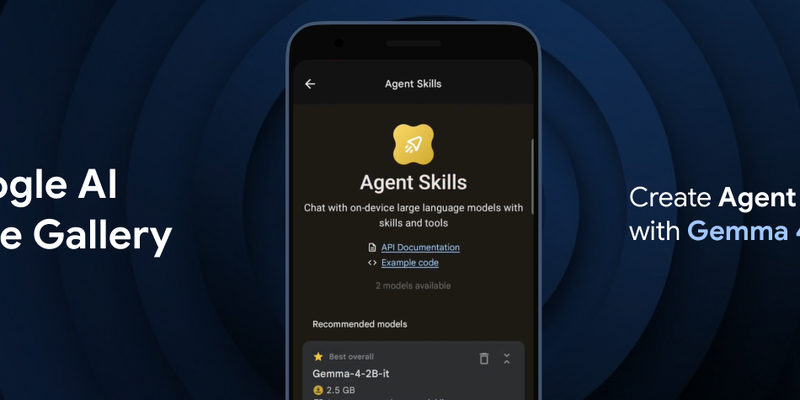
Google DeepMind has launched Gemma 4, a family of state-of-the-art open models designed to enable multi-step planning and autonomous agentic workflows directly on-device. The release includes the Google AI Edge Gallery for experimenting with "Agent Skills" and the LiteRT-LM library, which offers a significant speed boost and structured output for developers. Available under an Apache 2.0 license, Gemma 4 supports over 140 languages and is compatible with a wide range of hardware, including mobile devices, desktops, and IoT platforms like Raspberry Pi.
MARCH 30, 2026 / AI
Google has released version 1.0.0 of the Agent Development Kit (ADK) for Java, introducing powerful new features like Google Maps grounding, built-in URL fetching, and a standardized Agent2Agent protocol for cross-framework collaboration. The update enhances agent control through a new "App" and "Plugin" architecture, which allows for global logging, automated context window management via event compaction, and "Human-in-the-Loop" workflows for action confirmations. Additionally, the release provides robust session and memory services using Google Cloud integrations like Firestore and Vertex AI to manage long-term state and large data artifacts.
MARCH 23, 2026 / AI
This blog post introduces a workflow for extracting high-quality data from complex, unstructured documents by combining LlamaParse with Gemini 3.1 models. It demonstrates an event-driven architecture that uses Gemini 3.1 Pro for agentic parsing of dense financial tables and Gemini 3.1 Flash for cost-effective summarization. By following the provided tutorial, developers can build a personal finance assistant capable of transforming messy brokerage statements into structured, human-readable insights.
MARCH 18, 2026 / AI
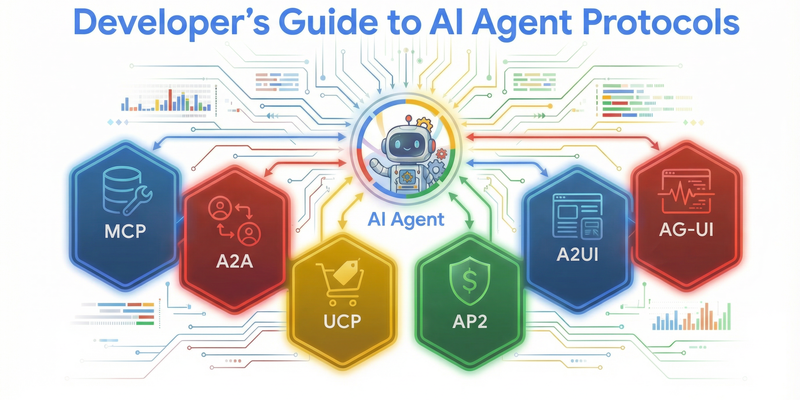
This blog post introduces a suite of six protocols, such as MCP and A2A, designed to eliminate custom integration code by standardizing how AI agents access data and communicate. Using a "kitchen manager" agent as a practical example, it demonstrates how these tools handle complex tasks like real-time inventory checks, wholesale commerce via UCP, and secure payment authorization through AP2. By leveraging the Agent Development Kit (ADK), developers can also implement A2UI and AG-UI to deliver interactive dashboards and seamless streaming interfaces to users.
MARCH 10, 2026 / AI
Google has introduced Finish Changes and Outlines for Gemini Code Assist in IntelliJ and VS Code to reduce developer friction and eliminate the need for long, manual prompting. Finish Changes acts as an AI pair programmer that completes code, implements pseudocode, and applies refactoring patterns by observing your current edits and context. Meanwhile, Outlines improves code comprehension by generating interactive, high-level English summaries interleaved directly within the source code to help engineers navigate and understand complex files.
MARCH 9, 2026 / Cloud
Wednesday Build Hour is a weekly, interactive "technical gym session" led by Google Cloud experts to help developers and architects sharpen their cloud skills. Moving beyond passive slide decks, the program focuses on hands-on building, covering advanced topics like AI agents, Vertex AI, and developer productivity tools. Each hour-long session is designed to provide tangible results that participants can immediately deploy into their own workflows. It serves as a consistent, dedicated space for builders to stay ahead of the curve and connect with a community of cloud engineers.
DEC. 19, 2025 / AI
Gemini 3 is powering the next generation of reliable, production-ready AI agents. This post highlights 6 open-source framework collaborations (ADK, Agno, Browser Use, Eigent, Letta, mem0), demonstrating practical agentic workflows for tasks like deep search, multi-agent systems, browser and enterprise automation, and stateful agents with advanced memory. Clone the examples and start building today.