
106 results
SEPT. 9, 2026 / Mobile
Google has officially released version 1.0 of the Agent Development Kit (ADK) for Kotlin, achieving full feature parity with the Python and Java ADK cores to enable idiomatic, multi-agent AI development. Built on Kotlin Multiplatform (KMP), the framework leverages Kotlin Symbol Processing (KSP) for zero-reflection, type-safe function calling, alongside advanced orchestration capabilities like human-in-the-loop workflows and context compaction. Additionally, the release introduces a robust suite of Android-first extensions, allowing mobile developers to integrate local models via LiteRT-LM, cloud reasoning through Firebase AI, session persistence using Room, and semantic memory powered by AppSearch.

SEPT. 9, 2026 / AI
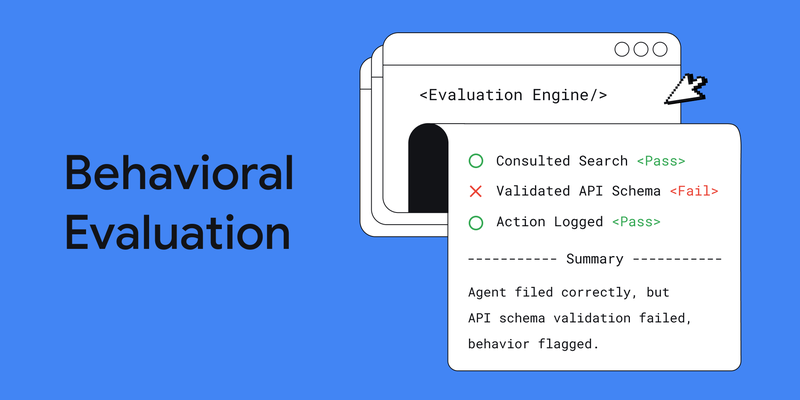
While end-to-end benchmarks like SWE-bench provide broad performance scores for AI agents, they are often expensive, slow, and lack the root-cause diagnostics needed to explain exactly where an agent's logic broke down. To solve this, developers should adopt behavioral evaluations—fast, local, unit-style tests that assert on discrete intermediate actions, such as verifying specific tool calls or file modifications rather than final string equality. By building these inexpensive micro-checks alongside macro benchmarks, engineering teams can confidently iterate on system prompts and upgrade models without the risk of regressions.
SEPT. 4, 2026 / AI
The Gemini Enterprise Developer Experience (DevEx) program conducts ongoing sprint testing of end-to-end developer workflows to identify and rapidly resolve friction points without relying on internal shortcuts. This recent sprint focused on optimizing enterprise AI governance, including refining setup prerequisites, securing extension configurations, and clarifying policy enforcement mechanics to ensure a smoother, more reliable deployment. Developers can now leverage updated documentation and standardized code samples to improve their experience with Agent Gateway and Semantic Governance configurations.

SEPT. 2, 2026 / AI
The recent Google for Startups AI Agents Challenge revealed that the most successful multi-agent systems rely on foundational software engineering patterns rather than just raw model power. Winning architectures consistently implemented bidirectional MCP for seamless inter-agent communication, async event buses for parallel execution, strict unified validation for model fallbacks, and tiered routing to minimize expensive inference calls. By prioritizing these structural practices over simple linear prompt chains, developers can build more resilient, low-latency, and cost-effective agentic workflows.

AUG. 17, 2026 / AI
Building autonomous AI agents that mutate production state requires moving beyond soft system prompts to a robust zero-trust architecture. To secure Google Agent Development Kit (ADK) workflows against prompt injections and malicious execution, developers must implement hardware-backed cryptographic signatures for database writes, kernel-level sandboxing with gVisor for dynamic code, and deterministic semantic gateways for I/O validation. By enforcing these hard security boundaries at the infrastructure level, you can safely deploy multi-tool AI agents without risking unauthorized data manipulation or server compromise.

AUG. 11, 2026 / AI
As AI coding assistants shift the developer's primary role from writing boilerplate to reviewing and maintaining systems, language choice becomes critical for long-term architectural integrity. Go directly addresses this new paradigm by utilizing its strict compiler, integrated toolchain, and uncompromising readability to provide deterministic guardrails that help AI models self-correct and generate highly standardized code. By enforcing ecosystem-wide consistency and strict backward compatibility, the Go platform empowers engineering teams to efficiently verify, optimize, and maintain high-velocity, AI-generated output in production environments.

AUG. 11, 2026 / Web
Deploying secure, real-time Edge AI on Raspberry Pi is now simplified using LiteRT and lightweight Gemma open models. LiteRT optimizes CPU and GPU performance, delivering fast token speeds for models like Gemma4, enabling real-time local reasoning for robotics. Developers can quickly convert, quantize, and run these models using the lightweight LiteRT CLI tool. Support for Hailo AI accelerators is also coming very soon.
AUG. 3, 2026 / AI
Real-time AI agents break traditional request-response load balancing paradigms because they rely on long-lived, stateful bidirectional streams that obscure true server capacity. To solve this, developers must implement application-level session tracking directly within the runtime to accurately measure the committed concurrent workload of active conversations. By feeding these precise session counts alongside standard CPU utilization metrics into a hybrid routing algorithm, infrastructure can effectively distribute stateful AI traffic and prevent individual backend bottlenecks.

JULY 31, 2026 / AI
To prevent context window bloat and reduce token consumption, Genkit Go introduces Agent Skills based on a progressive disclosure architecture. Developers can package specialized instructions, scripts, and references into modular SKILL.md bundles where only the frontmatter metadata is initially exposed to the agent's system prompt. When a task matches the skill's description, Genkit's middleware dynamically loads the full instruction body and associated assets, ensuring the model accesses precise workflows exactly when needed.

JULY 31, 2026 / AI
Agent Platform's evaluation service is now generally available, providing developers with a unified engine to measure agent quality consistently across local development experiments and live production traffic. You can evaluate agents using over 20 pre-built metrics, DeepMind-backed adaptive rubrics, or custom code-based and LLM-as-a-judge metrics stored in a centralized, versioned registry. The service integrates directly into existing workflows via the Agent Platform SDK, agents-cli, and ADK, offering built-in user and environment simulators to automate complex multi-turn testing and streamline CI pipelines.
