
Your contract compliance pipeline has a problem. The data science team wrote a brilliant extraction agent in Python. It uses Gemini to parse legal contracts and pull out every key term. The security engineering team built a blazing-fast compliance validator in Go, using all deterministic logic and no LLM. Both work perfectly in isolation. But now you need them to work together, as a single coordinated pipeline, and neither team is willing to rewrite their service in another language.
This is the reality of production AI systems: different teams, different languages, different deployment targets. The question isn't whether you'll face this; it's how you'll solve it.
In this post, we'll build a Contract Compliance Multi-Agent Pipeline where a Python agent extracts contract terms using Gemini and a Go agent validates them against corporate policy. The two services are connected by the Agent2Agent (A2A) protocol and orchestrated by Google's Agent Development Kit (ADK).
Along the way, you'll learn three architectural patterns that separate production multi-agent systems from single-language demos:
The complete source code is available on GitHub.
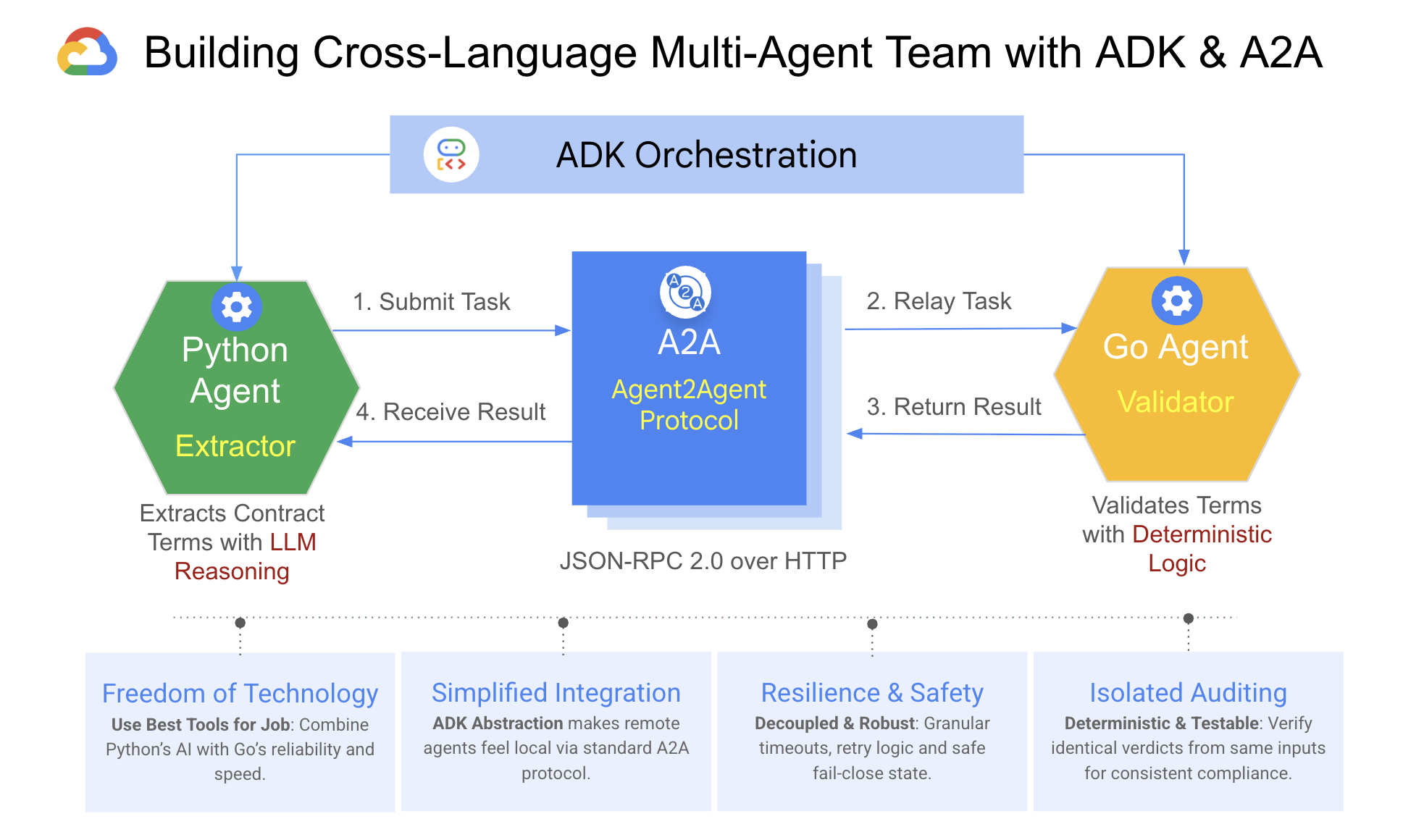
Most AI projects start the same way: one big agent, one massive prompt, every tool crammed into a single context window. It works for demos. It falls apart in production for three key reasons:
The fix is the same pattern that transformed backend engineering a decade ago: decompose the monolith into specialized microservices. Each agent gets one job, a focused prompt, and a minimal toolset.
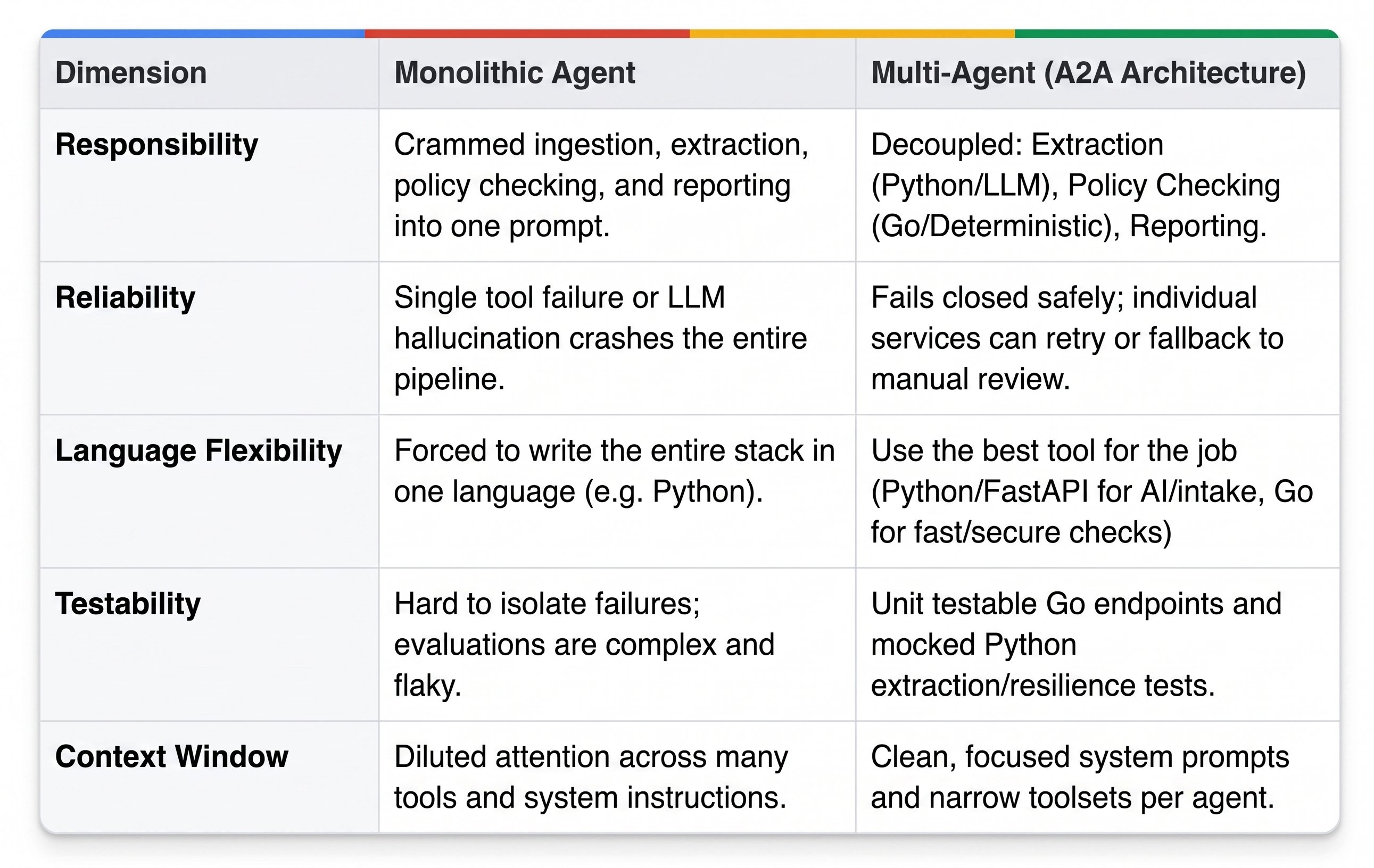
The Agent-to-Agent (A2A) protocol is an open standard that enables agents built in any language or framework to interoperate. Think of it as the HTTP of the agent world: a shared contract that lets any two agents communicate regardless of how they're built internally.
A2A solves three fundamental problems:
The beauty of this approach is that neither agent needs to know anything about the other's implementation. The Python agent doesn't import Go packages. The Go agent doesn't run Python code. They just speak a shared protocol over HTTP.
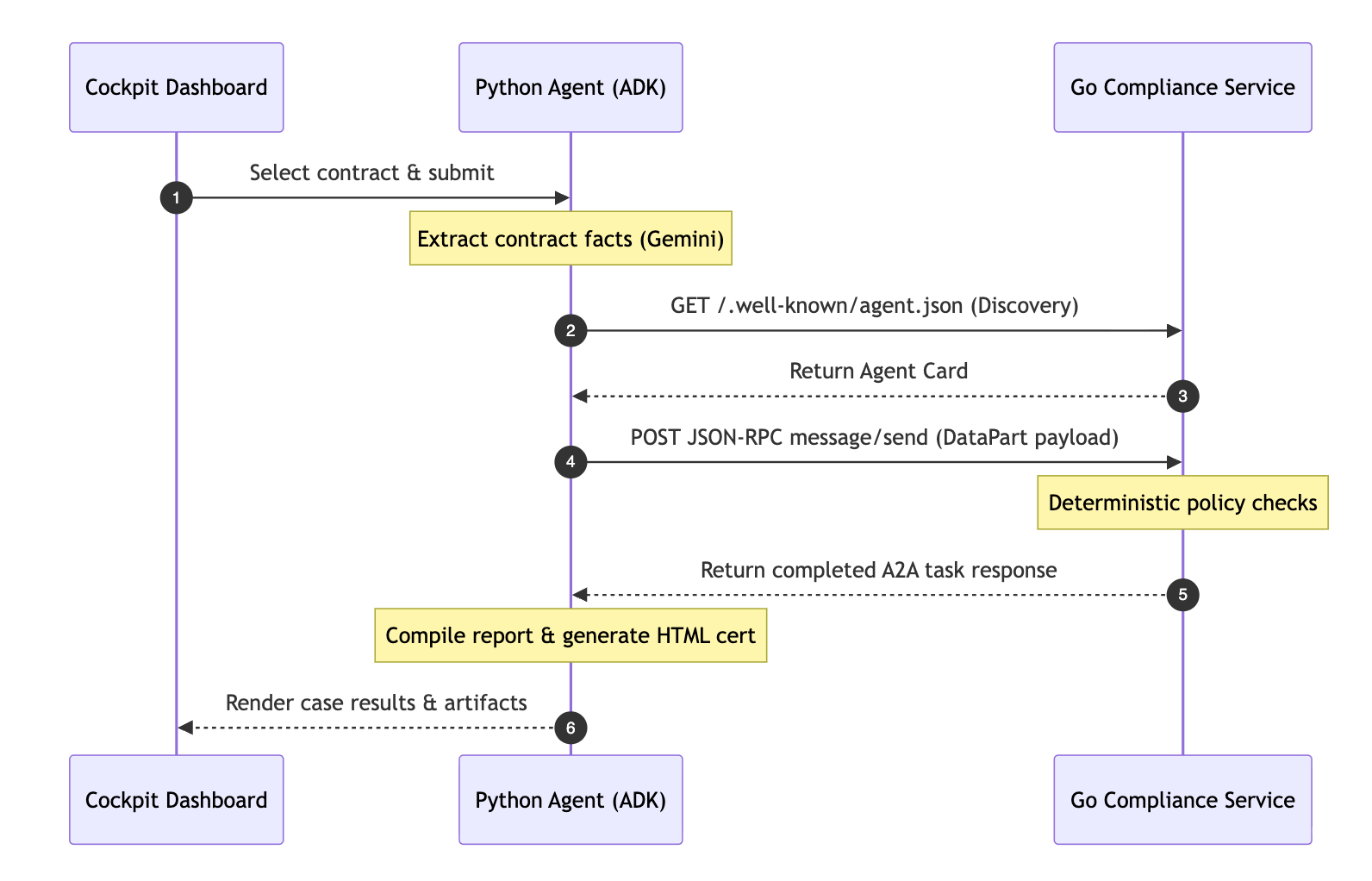
Here is the Agent Card the Go compliance service exposes at ‘/.well-known/agent.json’:
// go-compliance-agent/internal/agentcard/card.go
func GetCard() AgentCard {
	agentURL := os.Getenv("AGENT_URL")
	if agentURL == "" {
		agentURL = "http://localhost:8888"
	}

	return AgentCard{
		Name:        "Security Compliance Validator",
		Description: "Go-based validation engine that checks vendor contracts against corporate compliance policy rules.",
		Version:     "1.0.0",
		SupportedInterfaces: []AgentInterface{
			{
				URL:             agentURL,
				ProtocolBinding: "JSONRPC",
				ProtocolVersion: "1.0",
			},
		},
		Capabilities: Capabilities{
			ExtendedAgentCard: false,
		},
		DefaultInputModes:  []string{"application/json"},
		DefaultOutputModes: []string{"application/json"},
		Skills: []Skill{
			{
				ID:          "contract_compliance_check",
				Name:        "Contract Compliance Check",
				Description: "Validates extracted contract fields against corporate policy rules.",
				Tags:        []string{"compliance", "contract", "validation"},
				Examples: []string{
					"Check this contract for compliance violations",
					"Validate vendor agreement terms against policy",
				},
			},
		},
	}
}The URL is read from an environment variable so the same code works locally (‘localhost:8888’) and in containers (‘go-compliance-agent:8888’). The Skills array means a single agent can advertise multiple capabilities.
Here is how easily this cross-language team is assembled using the ADK in Python and a standard HTTP server in Go.
Before diving into individual agents, it's important to understand how they communicate. ADK's ToolContext.state provides a shared dictionary that all sub-agents in a pipeline read and write to. Rather than passing data between agents through function arguments or return values, agents communicate through a shared session state.
Each step in our compliance pipeline maps to a specific checkpoint:
class ComplianceStep(str, Enum):
    INGESTED = "INGESTED"                     # Contract uploaded, awaiting extraction
    EXTRACTED = "EXTRACTED"                    # Fields parsed by Gemini
    COMPLIANCE_PENDING = "COMPLIANCE_PENDING"  # Sent to Go agent, awaiting result
    COMPLIANCE_COMPLETE = "COMPLIANCE_COMPLETE"# Go agent returned verdict
    MANUAL_REVIEW = "MANUAL_REVIEW"           # Timeout or error, routed to human
    REVIEW_READY = "REVIEW_READY"             # Report generated, violations found
APPROVED = "APPROVED" # All checks passedThe MANUAL_REVIEW state is worth highlighting. If the Go compliance agent is unreachable for reasons like server crash, network timeout, container not started - the pipeline doesn't just fail. It transitions to MANUAL_REVIEW, routing the case to a human legal reviewer. This fail-safe pattern is essential for production systems where downstream services may be intermittently unavailable.
Using the ADK, you can define a remote A2A-compliant agent locally using `RemoteA2aAgent`. The SDK automatically handles the Agent Card handshake, parameter serialization, and JSON-RPC network requests behind the scenes.
# python-extraction-agent/app/agent.py
from google.adk.agents import Agent, SequentialAgent
from google.adk.agents.remote_a2a_agent import RemoteA2aAgent
from google.adk.models import Gemini


# Sub-Agent 1: Ingests & extracts details using LLM reasoning
extractor_agent = Agent(
   name="extractor_agent",
   model=Gemini(model="gemini-3.5-flash"),
   instruction="You are a Legal Data Extraction Agent. Extract contract fields: value, contractor, dates, insurance...",
   tools=[read_contract_text, save_extracted_fields, classify_risk_level]
)

# Sub-Agent 2: Go A2A Compliance Service wrapped as a local agent
compliance_agent = RemoteA2aAgent(
   name="compliance_agent",
   agent_card=GO_AGENT_CARD_URL,
   description="Validates extracted contract fields against corporate policies."
)

# Sub-Agent 3: Generates the final audit summary report
report_agent = Agent(
   name="report_agent",
   model=Gemini(model="gemini-3.5-flash"),
   instruction="Generate the final compliance report and Markdown summary.",
   tools=[generate_summary_report]
)

# Coordinator: Chains them together sequentially
root_agent = SequentialAgent(
   name="contract_compliance_coordinator",
    description="Orchestrates contract parsing, A2A compliance validation, and final reporting in sequence.",
   sub_agents=[extractor_agent, compliance_agent, report_agent],
)On the Go side, the compliance agent is a standard HTTP server that implements the A2A protocol. It exposes an Agent Card for discovery and a single JSON-RPC endpoint that accepts message/send requests, runs deterministic policy checks against the extracted contract fields, and returns a pass/fail verdict. No AI frameworks or SDKs needed — just the Go standard library.
Here's the simplified flow (the full implementation is in the repository):
// Simplified pseudo-code — see GitHub repository for full implementation


func HandleJSONRPC(w http.ResponseWriter, r *http.Request) {
    var req JSONRPCRequest
    json.NewDecoder(r.Body).Decode(&req)

    // Extract contract details from the A2A message
    var details compliance.ContractDetails
    extractContractFromMessage(req.Params, &details)

    // Run deterministic policy checks
    result := compliance.CheckCompliance(details, policy)

    // Return verdict as a JSON-RPC response
    writeJSONRPCResult(w, req.ID, result)
}The complete pipeline ships as an open source application you can deploy and extend. The repository includes a full-featured operations cockpit served by the FastAPI service.
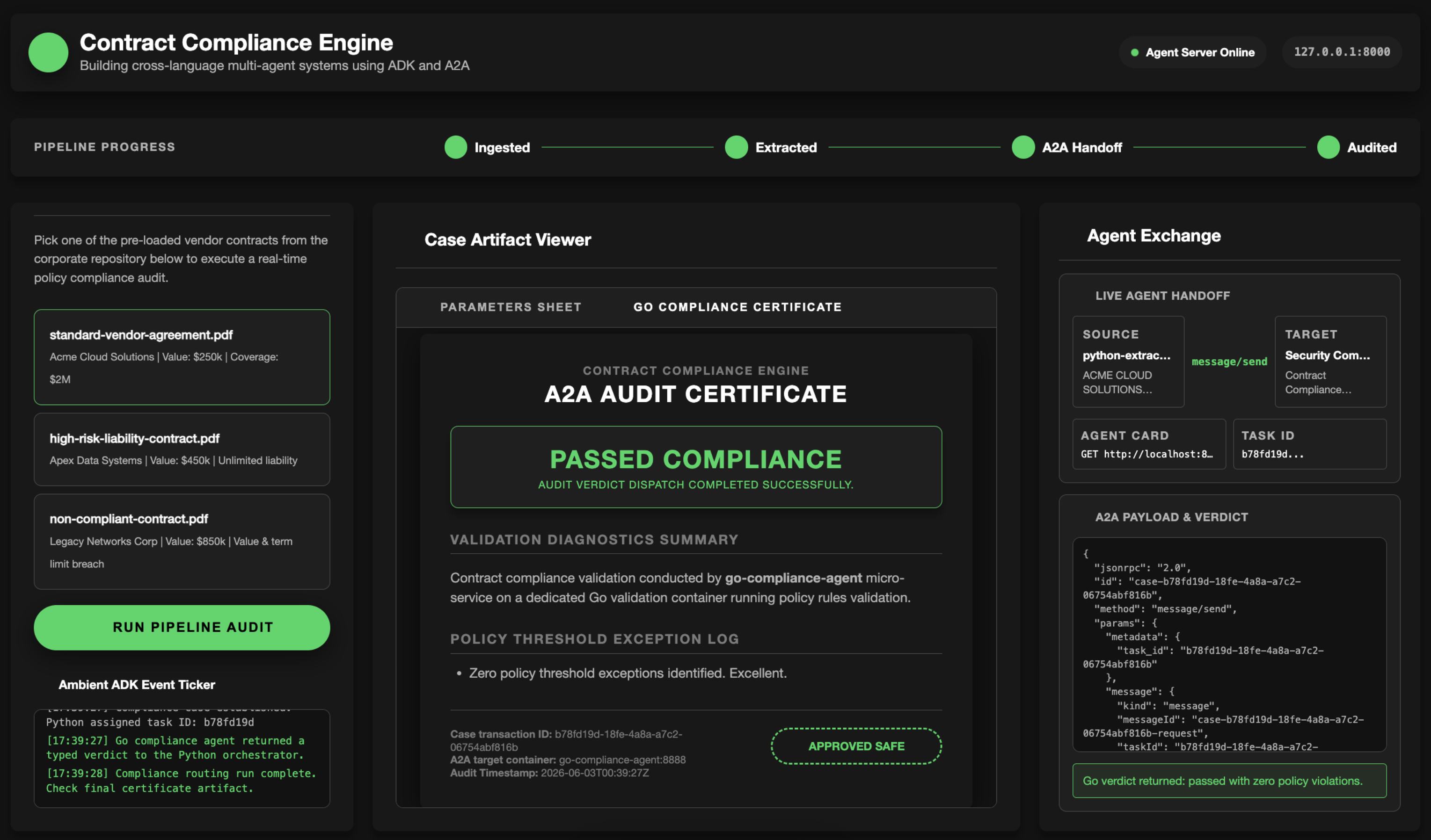
Multi-agent orchestration isn't just about chaining prompts; it's about building robust, cross-language distributed systems.
By bridging Python's AI ecosystem and Go's runtime reliability using Google ADK and the open A2A protocol, you get the best of both worlds: cognitive reasoning where there is ambiguity, and deterministic enforcement where there is policy.
Ready to run this yourself?

Architecting Governed, Self-Evolving AI Agents on Google Cloud
Integrating TorchTPU into TorchTitan and Optimizing Models for TPU
Streaming comes to API Gateway: real-time and AI-ready APIs, without changing your spec
Powering the Agent Development Lifecycle with any framework, from ADK to LangChain and beyond