240 results
DEC. 8, 2025 / Mobile
LiteRT and MediaTek are announcing the new LiteRT NeuroPilot Accelerator. This is a ground-up successor for the TFLite NeuroPilot delegate, bringing seamless deployment experience, state-of-the-art LLM support, and advanced performance to millions of devices worldwide.
DEC. 2, 2025 / AI
The new Data Commons extension for the Gemini CLI makes accessing public data easier. It allows users to ask complex, natural-language questions to query Data Commons' public datasets, grounding LLM responses in authoritative sources to reduce AI hallucinations. Data Commons is an organized library of public data from sources like the UN and World Bank. The extension enables instant data analysis, exploration, and integration with other data-related extensions.
NOV. 25, 2025 / AI
Gemini 3 is available via API with updates for developers: new `thinking_level` for depth control, `media_resolution` for multimodal processing, and enforced `Thought Signatures` for agentic workflows, especially with function calling and image generation. It also introduces combining Google Search/URL Grounding with Structured Outputs and new usage-based pricing for Grounding. Best practices, like using default temperature, are advised for optimal results.
NOV. 20, 2025 / AI
Introducing Google Antigravity, a new agentic development platform for orchestrating code. It combines an AI-powered Editor View with a Manager Surface to deploy agents that autonomously plan, execute, and verify complex tasks across your editor, terminal, and browser. Agents communicate progress via Artifacts (screenshots, recordings) for easy verification. Available now in public preview.
NOV. 19, 2025 / AI
Jules, an always-on, multi-step software development agent, now features Gemini 3, offering clearer reasoning and better reliability. Recent improvements include parallel CLI runs, a stable API, and safer Git handling. Upcoming features include directory attachment without GitHub and automatic PR creation. Jules aims to reduce software writing overhead so developers can focus on building.
NOV. 19, 2025 / AI
Gemini 3 Pro Preview is introduced as a powerful, agentic model for complex, (semi)-autonomous workflows. New agentic features include `thinking_level` for reasoning control, Stateful Tool Use via Thought Signatures, and `media_resolution` for multimodal fidelity. It has Day 0 support for open-source frameworks like LangChain, AI SDK, LlamaIndex, Pydantic AI, and n8n. Best practices include simplifying prompts and keeping temperature at 1.0.
NOV. 18, 2025 / AI
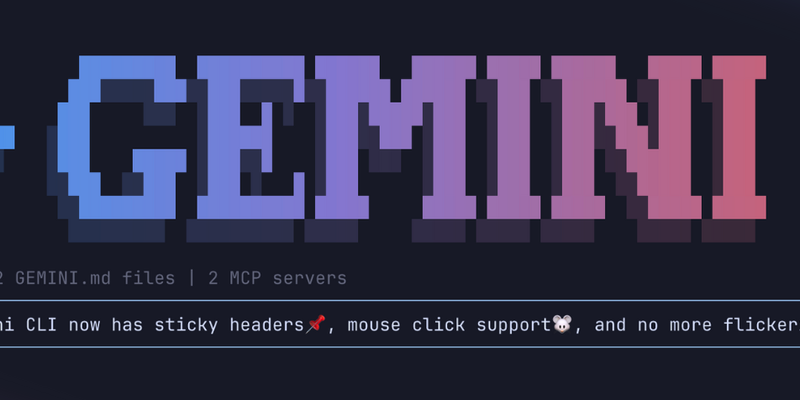
Gemini 3 Pro is now integrated into Gemini CLI, unlocking state-of-the-art reasoning, agentic coding, and advanced tool use for enhanced developer productivity. It's available now for Google AI Ultra and paid Gemini API key subscribers (upgrade CLI to 0.16.x). Features include generating 3D apps and code from visual sketches, running complex shell commands, creating documentation, and debugging live Cloud Run services.
NOV. 13, 2025 / AI
Google has launched the redesigned **Android AI Sample Catalog**, a dedicated, open-source application to inspire and educate Android developers on building AI-powered apps. It showcases examples using both on-device (Gemini Nano via ML Kit GenAI API) and Cloud models (via Firebase AI Logic SDK), including image generation with Imagen, on-device summarization, and a "Chat with Nano Banana" chatbot. The code is easy to copy and paste to help developers quickly start their own projects.
NOV. 13, 2025 / AI
Code Wiki is a new platform that tackles the bottleneck of reading existing code by providing an automated, continuously updated, structured wiki for code repositories. It features hyper-linked documentation, a Gemini-powered chat agent that understands your repo, and automated diagrams. A public preview is available for open-source projects, and a Gemini CLI extension is coming soon for secure use on private repos.
NOV. 7, 2025 / AI
The new **User Simulation** feature in the Agent Development Kit (ADK) replaces rigid, brittle manual test scripts with dynamic, LLM-powered conversation generation. Developers define a high-level `conversation_plan`, and the simulator handles the multi-turn interaction to achieve the goal. This dramatically reduces test creation time, builds more resilient tests, and creates a reliable regression suite for AI agents.