
4 results
JULY 21, 2026 / AI
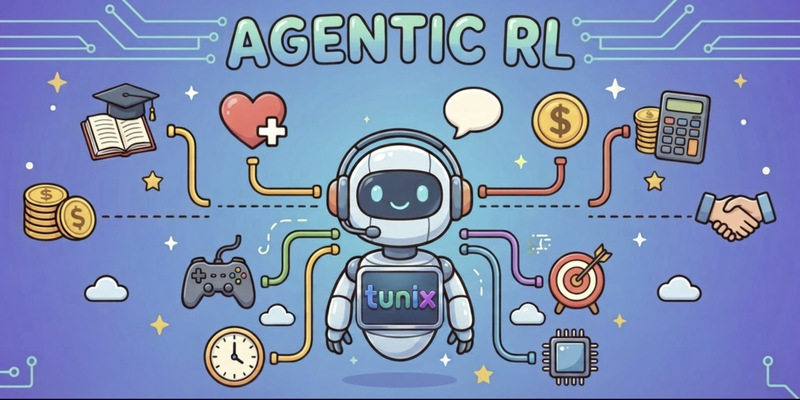
Tunix is Google’s new JAX-native post-training library designed to eliminate TPU idling bottlenecks when training multi-turn, tool-using LLM reasoning agents. It maximizes hardware throughput by combining highly concurrent, asynchronous rollouts with a decoupled producer-consumer pipeline, ensuring the trainer is constantly fed even while agents wait on network I/O or environment steps. Additionally, Tunix provides plug-and-play abstractions and continuous macro-level profiling, allowing developers to easily integrate custom open-source environments and optimize complex distributed workflows without massive code rewrites.
MAY 28, 2026 / AI
The Google Tunix Hackathon on Kaggle challenged developers to transform small, non-reasoning base models into general reasoning engines using Kaggle TPUs and a limited compute budget. The winning teams achieved this by implementing multi-stage post-training pipelines that combined Supervised Fine-Tuning (SFT) with advanced alignment techniques like GRPO and SimPO. Ultimately, the competition democratized AI development by proving that highly capable, structured reasoning models can be successfully trained by the community using accessible, open-source resources.

MAY 4, 2026 / AI
Researchers at UCSD have successfully implemented DFlash, a block-diffusion speculative decoding method, on Google TPUs to bypass the sequential bottlenecks of traditional autoregressive drafting. By "painting" entire blocks of candidate tokens in a single forward pass rather than predicting them one-by-one, the system achieved average speedups of 3.13x, with peak performance nearly doubling that of existing methods like EAGLE-3. This open-source integration into the vLLM ecosystem optimizes TPU hardware by leveraging "free" parallel verification and high-quality draft predictions for complex reasoning tasks.

APRIL 16, 2026 / AI
MaxText has introduced new support for Supervised Fine-Tuning (SFT) and Reinforcement Learning (RL) on single-host TPU configurations, leveraging JAX and the Tunix library for high-performance model refinement. These features enable developers to easily adapt pre-trained models for specialized tasks and complex reasoning using efficient algorithms like GRPO and GSPO. This update streamlines the post-training workflow, offering a scalable path from single-host setups to larger multi-host configurations.