
2834 results
OCT. 20, 2026 / Mobile
Google Research has completed the 32-bit open-source Coral NPU RISC-V architecture with the introduction of its Matrix Execution Unit, which delivers up to 1 TOPS while targeting 10 mW average power for edge inference. Alongside this architecture, the release of the v1.0 open-source IREE/MLIR compiler allows developers to take models from JAX, PyTorch, and TensorFlow straight to Coral NPU hardware without writing custom assembly. Developers can now prototype and deploy these multimodal edge applications using new hardware options like the Synaptics Astra SR200 MCU series and globally available Coralboard devkits.12

OCT. 20, 2026 / AI
TorchTPU integrates a native torch.device("tpu") backend directly into PyTorch, allowing developers to train large-scale models on Google Cloud TPUs without rewriting code in JAX. The TorchTitan TPU fork enhances this with production-grade scaling primitives like SimpleFSDP, Graph Trainer, and custom Pallas kernels that achieve high Model Flops Utilization (MFU) across dense and MoE architectures. Developers can leverage these battle-tested optimization playbooks, recipes, and the Hugging Face modeling backend to efficiently scale their own workloads on TPU infrastructure.

OCT. 20, 2026 / AI
This post announces native PyTorch backends for vLLM and SGLang powered by TorchTPU, enabling developers to run and optimize serving workloads using familiar PyTorch tools. Built in collaboration with open-source project maintainers, these engines include optimized TPU kernel implementations, production-ready features like KV cache management with TPU Sync, and disaggregated serving. Public benchmarks demonstrate state-of-the-art performance and industry-leading cost efficiency on Ironwood TPU across long-context and agentic workloads.

OCT. 20, 2026 / Mobile
Google AI Edge Model Explorer now supports custom compiler intermediate representations and open-source adapters like TOSA, VGF, and PTE for on-device machine learning. Developers can leverage hierarchical graph visualization, split-pane views, and per-node trace overlays to catch export regressions and verify hardware delegation. These tools enable engineering teams to transparently debug execution graphs and pinpoint cycle-level latency bottlenecks locally.

OCT. 19, 2026 / Mobile
Meet the LiteRT Tensor API: giving developers native C++ control over the model graph to unify end-to-end ML computations on heterogeneous edge hardware.

OCT. 19, 2026 / AI
The open-source Agent Development Kit (ADK) and gemini-3.8-live enable developers to build responsive voice agents by implementing non-blocking tools in Python. Developers can use streaming tools to yield progress updates or background execution patterns to keep conversations fluid during long-running backend queries. Additionally, configuring response scheduling behaviors such as WHEN_IDLE, INTERRUPT, or SILENT gives developers precise control over when and how tool results are delivered into the conversation.

OCT. 15, 2026 / Mobile
Google OAuth Platform now supports DPoP (Demonstrating Proof-of-Possession) to sender-constrain refresh tokens, neutralizing Infostealer malware and adversary-in-the-middle attacks. By cryptographically binding long-lived refresh tokens while maintaining short-lived access tokens as standard Bearer tokens, developers achieve robust credential security without incurring high-QPS API performance overhead. Additionally, developers integrating multi-agent or Model Context Protocol (MCP) workloads can use Google Cloud Secure Token Service (STS) to handle secure token delegation across agent chains.

OCT. 15, 2026 / AI
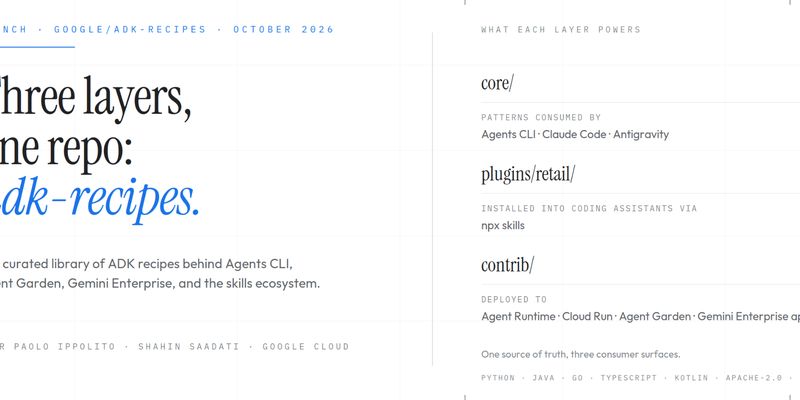
The google/adk-recipes repository unifies Agent Development Kit (ADK) resources into three structured layers—core/, plugins/, and contrib/—serving as a single source of truth for building AI agents. Developers can leverage reference patterns, install modular vertical skills (such as retail product search and virtual try-on) directly into their coding assistants, and deploy production-ready services across multiple languages. This cohesive structure streamlines the entire workflow from initial scaffolding to full deployment on Google Cloud infrastructure.
OCT. 15, 2026 / AI
A practical engineering guide and reference architecture for establishing continuous evaluation pipelines for multi-turn AI agents using Gemini Enterprise Agent Platform, Google ADK, and OpenInference standards.

OCT. 14, 2026 / AI
Apigee hybrid 1.17.0 introduces native Model Context Protocol (MCP) support, enabling the MCP data plane to run directly within your own Kubernetes cluster. This architecture ensures that AI agent request traffic and tool execution remain entirely inside your infrastructure while pulling configuration updates from the control plane. Developers can expose OpenAPI 3.0.x specifications as discoverable MCP tools, leverage existing security policies and API products, and trace end-to-end requests using W3C trace context headers.
