311 results
JULY 16, 2026 / AI
Conductor has evolved from a Gemini CLI extension into a portable plugin, bringing conversational Spec-Driven Development (SDD) to ecosystems like Antigravity CLI and Claude. Rather than relying on strict command sequences, developers can now chat naturally with their AI assistant while it dynamically manages persistent markdown artifacts (like spec.md and plan.md) in the background. This update eliminates workflow friction while ensuring your repository remains a version-controlled, single source of truth for your project's architecture and state across different AI tools.
JULY 14, 2026
To serve the 397B-parameter Qwen 3.5 Mixture-of-Experts (MoE) model on Ironwood TPUs, engineers developed a modular JAX/Pallas optimization stack that achieved up to a 4.7x inference speedup for prefill-heavy workloads. The team bypassed severe hardware sharding constraints by deploying a hybrid Data Parallelism and Expert Parallelism (DP+EP) topology, paired with custom low-level communication fusions like a hierarchical reduce-scatter to optimize cross-device token routing. Finally, by executing hardware-aware custom kernels—such as Batched Ragged Page Attention and a fully-fused Gated DeltaNet (GDN) block—they successfully saturated HBM bandwidth and TensorCore MXUs to push system throughput near its theoretical roofline limits.

JULY 8, 2026 / Mobile
On May 23, 2026, fresh off the stage at Google I/O, our Google Developer Experts (GDEs) converged on...

JULY 1, 2026 / AI
The Google Cloud Workbench Notebooks extension for VS Code has officially launched, allowing developers to connect their local IDE to scalable, cloud-based Jupyter environments. This integration streamlines the machine learning lifecycle by eliminating context switching and providing direct access to high-performance Google Cloud infrastructure. To support transparency and community-driven innovation, the newly released extension is fully open-sourced and available on GitHub and the VS Code Marketplace.

JULY 1, 2026 / AI
Answering the questions of "why we built ADK 2.0". This explains the rationale, some of the features, and why a developer should consider upgrading. This will be published the day after ADK go 2.0 launches.

JUNE 18, 2026 / AI
Celebrating the first anniversary of the Agent-to-Agent (A2A) protocol, this blog post highlights how the framework enables autonomous AI agents to securely collaborate and hand off tasks without the rigidity of traditional APIs. By delegating complex workflows to specialized peer agents, A2A prevents context pollution, ensures data privacy, and simplifies application design through modularity. To demonstrate this ecosystem in action, the post spotlights FoldRun—an agentic interface for life sciences that orchestrates complex protein structure predictions—alongside diverse A2A use cases spanning commerce, data streaming, DevOps, and telecommunications.

JUNE 17, 2026 / Web
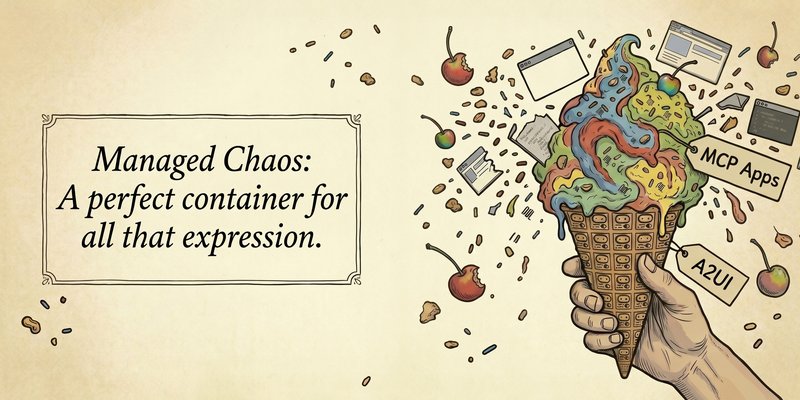
This post introduces three architectural patterns designed to integrate Model Context Protocol (MCP) Apps and Agent-to-User Interface (A2UI) to solve the tradeoff between highly custom iframe environments and native, declarative rendering. By combining these approaches, developers can serve native-feeling UIs directly over MCP servers, embed complex and stateful iframe apps securely inside declarative views, or inject generative UI components into legacy systems. Ultimately, these hybrid frameworks empower engineering teams to deliver secure, performant, and brand-consistent agentic user experiences tailored to their specific project constraints.
JUNE 16, 2026 / Mobile
Google is enhancing Sign in with Google by introducing new OIDC standard claims—specifically auth_time and amr (Authentication Methods Reference) to provide developers with deeper session metadata. These updates allow verified apps to verify the "freshness" of a user's login and the specific authentication methods used (such as MFA or hardware keys), enabling more dynamic, risk-based access controls. By leveraging these federated identity signals, platforms can better prevent account takeover and fraud while implementing granular security policies like step-up authentication for sensitive actions.

JUNE 16, 2026 / AI
Google has officially launched the TPU Developer Hub, a centralized educational resource designed to help model builders and developers maximize the performance of Google Cloud TPUs. The hub offers code-first resources, open-source recipes, and deep-dive documentation covering hardware architecture, software optimization, debugging, parallelism, and networking. These materials are tailored for both human developers and AI-assisted tools to streamline everything from large-scale training to low-latency inference workloads.

JUNE 10, 2026 / AI
DiffusionGemma is an experimental text-generation model built on the Gemma 4 architecture that uses diffusion-based parallel generation instead of token-by-token autoregression, enabling much faster inference, bidirectional context awareness, and real-time self-correction while remaining deployable on consumer GPUs. Its architecture generates and refines 256-token blocks in parallel through iterative denoising, allowing it to handle complex constraint-based tasks such as Sudoku more effectively than traditional language models and demonstrating strong gains from fine-tuning. The model integrates with vLLM and other popular inference frameworks, giving developers access to a new non-autoregressive approach that combines high performance, efficient long-context scaling, and straightforward customization and deployment.