329 results
NOV. 20, 2026 / Cloud
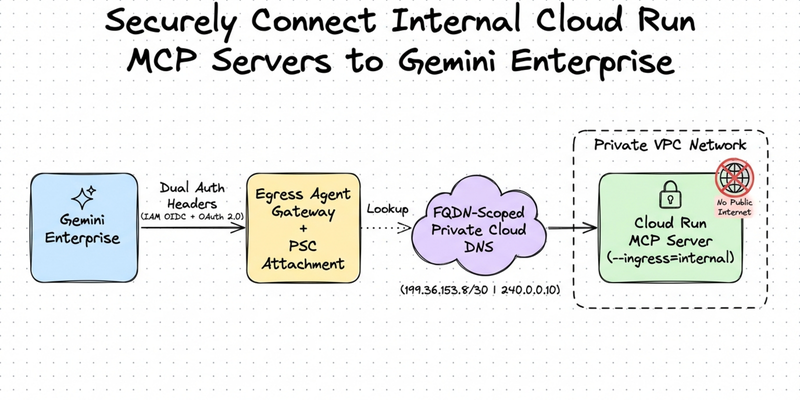
How to connect Gemini Enterprise privately to internal StreamableHTTP MCP servers on Cloud Run using Egress Agent Gateway, Private Service Connect, FQDN-scoped Private Cloud DNS, and dual-header OAuth 2.0 authentication.
NOV. 20, 2026 / Cloud
When building a custom enterprise UI on top of Gemini Enterprise's :streamAssist API, developers must manually implement three core authentication layers. These include authenticating users or workloads via Google Identity or Workforce/Workload Identity Federation, managing third-party 3-legged OAuth (3LO) for Federated Connectors through the Keystore, and configuring on-demand per-tool OAuth for custom ADK agents using Vertex AI Agent Engine and GCP Auth Manager.

NOV. 20, 2026 / AI
Agent Anomaly Detection now monitors ADK agents running across AWS, Azure, or on-premises by analyzing their traces and logs in your Google Cloud project. By ingesting OpenTelemetry-formatted data through the Telemetry API, it evaluates full conversations for behavioral drift without needing access to the agent's underlying runtime. This enables security teams to detect risks like rogue behaviors, tool misuse, and resource exhaustion across multi-cloud environments.

NOV. 20, 2026 / Gemini
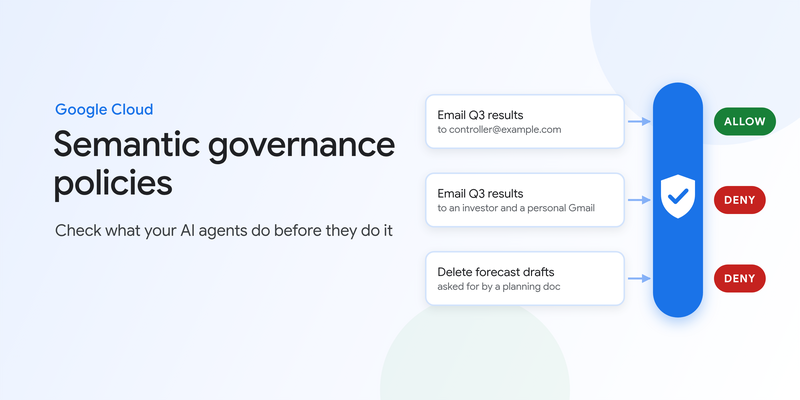
Semantic governance policies enable developers to govern AI agents by evaluating every proposed tool call inline before execution. Operating via Agent Gateway, the policy engine checks each action against user intent and plain-language rules to prevent unauthorized data sharing and prompt injection attacks. Developers can easily attach natural-language constraints to their agents and monitor auditable verdicts through Cloud Logging.
NOV. 17, 2026 / AI
Google's Gemini 4 Hydrogen brings strong spatial and embodied reasoning capabilities to a fast, efficient model built specifically for robotics. To help developers put these capabilities to work, the new Robotics plugin for Google Antigravity transforms the platform into a comprehensive workbench supporting rapid hardware bring-up, MuJoCo simulation, and closed-loop control. Developers can leverage these tools to transition from an unboxed robot arm to a fully functional real-to-sim-to-real application in an afternoon using natural language prompts and day-one support in the google-genai SDKs.
NOV. 16, 2026 / AI
This guide walks developers through setting up Agent Anomaly Detection on the Gemini Enterprise Agent Platform to monitor AI agent telemetry and catch behavioral risks. It demonstrates how to deploy a sample customer support agent, trigger out-of-scope security findings, and configure proactive alerts using Cloud Monitoring and Security Command Center.

NOV. 12, 2026 / AI
Agent Anomaly Detection (AAD) provides asynchronous, low-latency monitoring for AI agents by analyzing OpenTelemetry traces and logs to flag goal hijacks and tool misuse. Tested across five public security benchmarks, AAD successfully caught 87% of harmful instructions carried out by agents without adding runtime latency. Developers can integrate AAD alongside semantic governance and strict tool limits as part of a defense-in-depth strategy to secure agentic applications.

NOV. 12, 2026 / AI
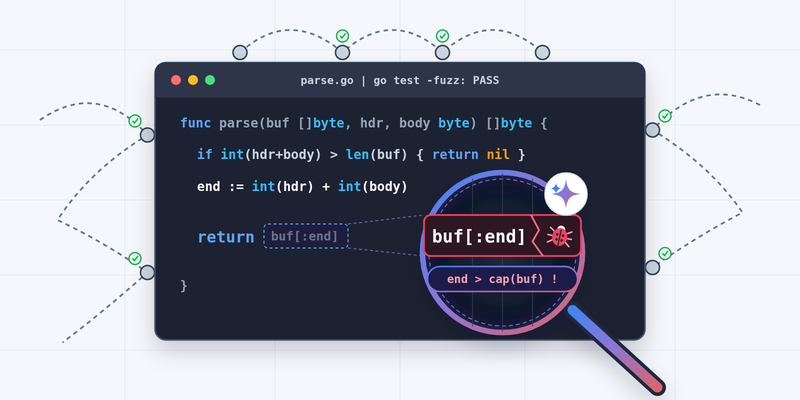
How pairing Go's surviving compiler bounds-check traps with Gemini 4 Argon and the Z3 constraint solver catches latent out-of-bounds panics in Go code and uncovers a slice-capacity blind spot in go test -fuzz.
NOV. 11, 2026 / Mobile
A2UI 1.0 is an open protocol for generative UI that enables AI agents to render interactive, native screens across web, mobile, and desktop applications. Developers can leverage open-source renderer SDKs—including React, Angular, Lit, Flutter, SwiftUI, and Jetpack Compose—alongside agent SDKs for Python, TypeScript, and Dart. The release introduces bidirectional function calls, swappable inference formats, and secure data binding to help teams seamlessly integrate generative UI into their product stacks.

NOV. 9, 2026 / Mobile
Developers can now build applications powered by Google Maps Platform directly within Google AI Studio by prompting Gemini with real-world geospatial concepts. The integration eliminates traditional configuration hurdles by providing one-click demo keys that generate instantly without requiring Cloud Console redirects or credit cards. This setup grants developers immediate access to core APIs—including Maps, Places, and Routes—supported by daily sandbox quotas for seamless prototyping.