
200 results
OCT. 15, 2026 / AI
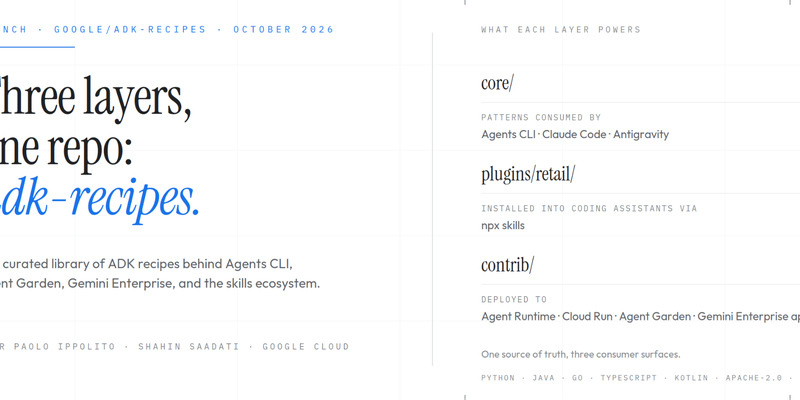
The google/adk-recipes repository unifies Agent Development Kit (ADK) resources into three structured layers—core/, plugins/, and contrib/—serving as a single source of truth for building AI agents. Developers can leverage reference patterns, install modular vertical skills (such as retail product search and virtual try-on) directly into their coding assistants, and deploy production-ready services across multiple languages. This cohesive structure streamlines the entire workflow from initial scaffolding to full deployment on Google Cloud infrastructure.
OCT. 15, 2026 / AI
A practical engineering guide and reference architecture for establishing continuous evaluation pipelines for multi-turn AI agents using Gemini Enterprise Agent Platform, Google ADK, and OpenInference standards.

OCT. 14, 2026 / AI
Apigee hybrid 1.17.0 introduces native Model Context Protocol (MCP) support, enabling the MCP data plane to run directly within your own Kubernetes cluster. This architecture ensures that AI agent request traffic and tool execution remain entirely inside your infrastructure while pulling configuration updates from the control plane. Developers can expose OpenAPI 3.0.x specifications as discoverable MCP tools, leverage existing security policies and API products, and trace end-to-end requests using W3C trace context headers.

OCT. 13, 2026 / Gemini
How our engineering team ran Gemini 4 Argon unattended overnight with .agents/skills and /goal mode to cut in-memory session prep overhead by 40% in long sessions and speed up cold imports by 21% in Google's open-source Python Agent Development Kit (ADK).

OCT. 8, 2026 / AI
How do you keep improving an AI agent after the first 80%, once it serves real production traffic and silent quality regressions return HTTP 200 OK? We are open-sourcing AQuA (Ambient Quality Agent), a reference implementation that runs beside your production agent in Google Cloud, sweeps and verifies failure clusters against conversation transcripts, and diagnoses root causes anchored to the exact deployed source snapshot.

SEPT. 30, 2026 / AI
To address the quadratic latency bottleneck of self-attention in high-resolution video diffusion models, developers implemented Sparse VideoGen (SVG) to dynamically route attention heads to highly structured spatial or temporal sparse masks. Translating this algorithmic sparsity into physical hardware speedups on TPUs required optimizing the Splash Attention kernel by bypassing empty memory tiles, restricting exact coordinate masking strictly to boundary tiles, and permuting token memory layouts into temporal-major order for contiguous access. By aligning these sparse masks with actual hardware tile execution, the combined optimizations significantly reduced wasted matrix operations and achieved up to a 1.69x end-to-end inference speedup for 1440p video generation.

SEPT. 24, 2026 / AI
The MaxText team successfully reproduced Ai2’s Olmo 3 7B language model from scratch on Google Cloud TPUs using JAX/XLA, precisely matching the original PyTorch-on-GPU reference across pre-training and mid-training stages on all held-out evaluations. The implementation achieved up to 57.4% Model Flops Utilization (MFU) and demonstrated robust infrastructure portability by surviving mid-run cluster resizes and cross-generation TPU shifts without requiring recipe alterations. Crucially, the exercise proved the necessity of comprehensive held-out validation by catching a silent data-loader memorization bug that artificially depressed training loss and would have otherwise faked a performance win.

SEPT. 24, 2026 / AI
Google Cloud API Gateway now acts as a native remote Model Context Protocol (MCP) server, eliminating the need to build and maintain custom middleware to expose REST APIs to AI agents. By simply adding specific annotations (like x-google-api-management.mcp) to existing OpenAPI 3.x specifications, developers can instantly convert standard REST operations into discoverable, agent-ready tools. The gateway automatically transcodes incoming MCP JSON-RPC requests into REST calls, ensuring that your existing authentication, quotas, and logging policies apply seamlessly to agent traffic without requiring new infrastructure.

SEPT. 16, 2026 / AI
Agent Anomaly Detection is a new, out-of-band oversight layer for the Gemini Enterprise Agent Platform that analyzes OpenTelemetry traces and tool calls to catch behavioral risks without adding runtime latency to live requests. It utilizes a multi-tiered detection pipeline—combining lightweight statistical scanning with deep LLM-based reasoning—to identify logical anomalies and policy violations grounded in the OWASP Agentic Top 10. Developers can triage these automated findings within Security Command Center or leverage the exposed API to programmatically block subsequent tool calls when an agent breaches defined risk thresholds.

SEPT. 15, 2026 / AI
This blog post explores how to transition AI agents from static, build-time security controls to dynamic runtime governance using the Gemini Enterprise Agent Platform. It highlights three primary managed defenses: Model Armor for screening edge prompts, Semantic Governance Policies for evaluating tool intent against business rules, and Agent Anomaly Detection for catching multi-turn exploits. By shifting these capabilities to the platform level, security administrators can dynamically enforce policies and neutralize complex attacks without needing to modify or redeploy the agent's underlying code.
