
When building AI applications, developers need the freedom to route traffic to the best model for the job without hardcoding endpoints or managing open-source proxies. Google Cloud API Gateway now offers model routing in Public Preview to solve this. It provides a lightweight, serverless ingress layer that accepts OpenAI-compatible requests and dynamically routes them to Gemini, Claude, or OpenAI OSS-GPT. This AI gateway pattern is commonly referred to as an LLM gateway or centralized LLM endpoint.
API Gateway can be used standalone for simple rules-based routing, rate limiting and token tracking, or paired seamlessly with Google Cloud’s broader AI gateway spectrum and Gemini Enterprise Agent Platform. For example, you can route your agent's egress through Agent Gateway for strict security governance, and then pass the request to API Gateway to handle dynamic routing to Google-hosted LLMs. Here is a step-by-step guide on how to configure your routing logic.
This gives you a single, stable endpoint for all your LLM traffic, so you can add or swap backend models centrally without changing client code. And because applications authenticate to the Gateway, not to the model providers, client auth stays separate from backend LLM auth, letting you rotate or change backend credentials without touching your apps.
x-google-api-management extension block.openapi: 3.0.4
info:
title: OpenAPI 3.x spec using Model Routing
description: Using Model Routing in an OAS 3.x spec
version: 1.0.0
x-google-api-management:
backends:
gemini-35-flashlite:
address: >-
https://aiplatform.googleapis.com/v1/projects/YOUR_PROJECT_ID/locations/global/publishers/google/models/gemini-3.5-flash-lite:generateContent
deadline: 60.0
pathTranslation: CONSTANT_ADDRESS
anthropic-claude-opus-47:
address: >-
https://aiplatform.googleapis.com/v1/projects/YOUR_PROJECT_ID/locations/global/publishers/anthropic/models/claude-opus-4-7:rawPredict
deadline: 60.0
pathTranslation: CONSTANT_ADDRESS
openai-gpt-oss-120b:
address: >-
https://aiplatform.googleapis.com/v1/projects/YOUR_PROJECT_ID/locations/global/endpoints/openapi/chat/completions
deadline: 60.0
pathTranslation: CONSTANT_ADDRESS
ai:
models:
routing:
routers:
# Router 1: route between Gemini (default) and Claude.
gemini-claude-router:
defaultModel:
backend: gemini-35-flashlite
targetModel: google/gemini-3.5-flash-lite
rules:
- model: "claude-opus-4-7"
backend: anthropic-claude-opus-47
targetModel: anthropic/claude-opus-4-7
# Router 2: route between OpenAI GPT (default) and Gemini.
openai-gemini-router:
defaultModel:
backend: openai-gpt-oss-120b
targetModel: openai/gpt-oss-120b-maas
rules:
- model: "gemini-3.5-flash-lite"
backend: gemini-35-flashlite
targetModel: google/gemini-3.5-flash-lite
servers:
- url: "https://my-gateway.example.com"
paths:
/v1/chat/gemini-claude:
post:
summary: "Endpoint:defaults to Gemini & Claude as an option."
operationId: "chatGeminiClaude"
x-google-model-router: gemini-claude-router
responses:
'200':
description: "OK"
/v1/chat/openai-gemini:
post:
summary: "Endpoint:defaults to OpenAI & Gemini as an option."
operationId: "chatOpenAIGemini"
x-google-model-router: openai-gemini-router
responses:
'200':
description: "OK"Note: All backends referenced by a single router must share the same host (for example, aiplatform.googleapis.com). Routing selects a different model and path on that shared Agent Platform host — it does not route across different hosts.
2. Deploy the Gateway: Deploy your updated API config so the Gateway is active and ready to process traffic.
3. Send standard requests: Your application simply sends a standard OpenAI POST /v1/chat/gemini-claude or POST /v1/chat/openai-gemini request. The Gateway intercepts it, transcodes the payload to the native schema of the backend, adds the required agent platform authentication token, and routes it on the fly. As an example (use appropriate values for $API_KEY and my-gateway.example.com) :
curl -X POST "https://my-gateway.example.com/v1/chat/gemini-claude" \
  -H "content-type: application/json" \
  -H "x-api-key: $API_KEY" \
  -d '{
        "model": "claude-opus-4-7",
        "messages": [
          {"role": "user", "content": "Introduce yourself in 5 words"}
        ]
}'Model routing is now available in Public Preview for API Gateway. To stop managing proxies and start unifying your AI traffic, check out our documentation to deploy your first model router today.
These model routing capabilities are part of Google Cloud's broader AI gateway spectrum: expansive API and tools management with Apigee, and end-to-end agent governance with Agent Gateway in the Gemini Enterprise Agent Platform, so you can start lightweight and grow into the rest when you need it.

Architecting Governed, Self-Evolving AI Agents on Google Cloud

Step by Step guide: Build a Voice Agent That Never Goes Silent using ADK

Announcing DPoP Support for Google OAuth: Securing Refresh Tokens
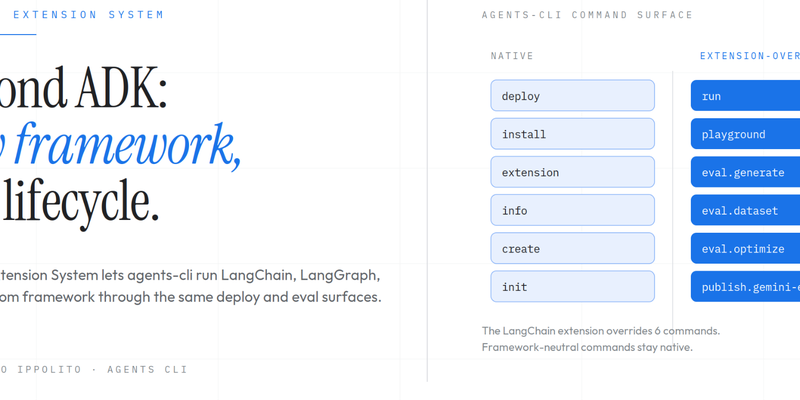
Powering the Agent Development Lifecycle with any framework, from ADK to LangChain and beyond