
85 results
OCT. 29, 2026 / Mobile
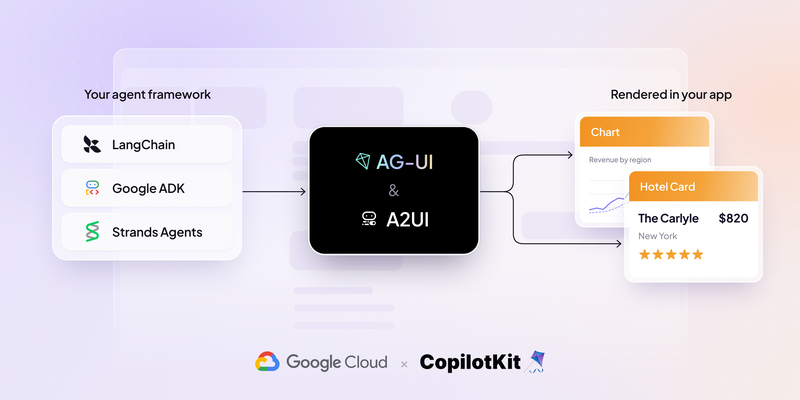
See Google A2Ui in action! Learn how to natively render agentic UIs across Langchain, AWS Strands, Microsoft agents, and Google ADK using CopilotKit SDKs for A2UI.
OCT. 28, 2026 / Mobile
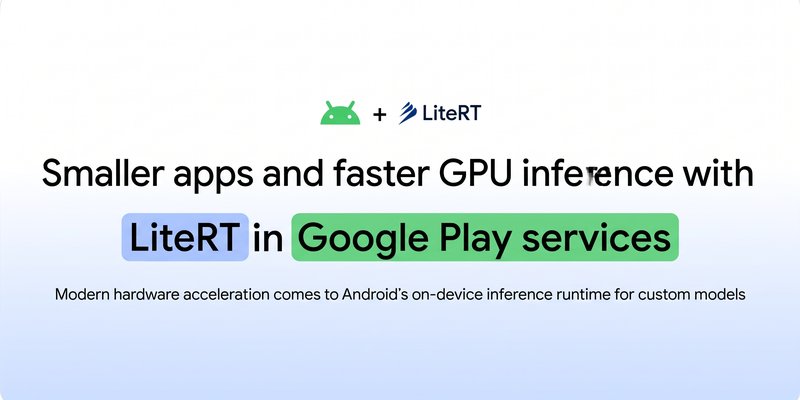
LiteRT in Google Play services now offers GPU inference powered by ML Drift, delivering about 1.4x faster performance alongside the new CompiledModel API. Switching from bundled binaries reduces app size by approximately 8 MB while enabling seamless, automatic runtime updates across billions of devices. Developers can easily adopt these updates by updating their dependencies and utilizing the new Android Studio LiteRT skill for automated migration.
OCT. 27, 2026 / Mobile
This document provides a publication template and metadata structure for a technical blog post focused on building Conversational User Interfaces (CUIs) using AI. It outlines key developer focus areas, product stacks, and approval workflows required for publishing technical content through Google Developer Studio. The framework helps engineers organize their guides and solutions to effectively share AI-driven conversational interface designs with the developer community.

OCT. 27, 2026 / Mobile
A2UI now supports swappable inference formats, introducing A2UI Express which uses up to 3x fewer tokens and cuts latency by compiling compact Python-style syntax into standard A2UI JSON via Agent SDKs. Developers can also use controlled generation with TypeSafe's Jev system-decision models to render known-shape screens in under 300 ms while smaller models stream text. These updates require no changes to frontend renderers or component catalogs, offering flexible performance levers for generative UI development across Python, TypeScript, and Dart.

OCT. 20, 2026 / Mobile
Google AI Edge Model Explorer now supports custom compiler intermediate representations and open-source adapters like TOSA, VGF, and PTE for on-device machine learning. Developers can leverage hierarchical graph visualization, split-pane views, and per-node trace overlays to catch export regressions and verify hardware delegation. These tools enable engineering teams to transparently debug execution graphs and pinpoint cycle-level latency bottlenecks locally.

OCT. 20, 2026 / Mobile
Google Research has completed the 32-bit open-source Coral NPU RISC-V architecture with the introduction of its Matrix Execution Unit, which delivers up to 1 TOPS while targeting 10 mW average power for edge inference. Alongside this architecture, the release of the v1.0 open-source IREE/MLIR compiler allows developers to take models from JAX, PyTorch, and TensorFlow straight to Coral NPU hardware without writing custom assembly. Developers can now prototype and deploy these multimodal edge applications using new hardware options like the Synaptics Astra SR200 MCU series and globally available Coralboard devkits.12

OCT. 19, 2026 / Mobile
Meet the LiteRT Tensor API: giving developers native C++ control over the model graph to unify end-to-end ML computations on heterogeneous edge hardware.

OCT. 15, 2026 / Mobile
Google OAuth Platform now supports DPoP (Demonstrating Proof-of-Possession) to sender-constrain refresh tokens, neutralizing Infostealer malware and adversary-in-the-middle attacks. By cryptographically binding long-lived refresh tokens while maintaining short-lived access tokens as standard Bearer tokens, developers achieve robust credential security without incurring high-QPS API performance overhead. Additionally, developers integrating multi-agent or Model Context Protocol (MCP) workloads can use Google Cloud Secure Token Service (STS) to handle secure token delegation across agent chains.

OCT. 8, 2026 / Mobile
Google AI Edge has introduced ML Drift, a high-performance, universal GPU compute framework designed to accelerate on-device AI and machine learning inference. By abstracting the complexities of hardware and low-level APIs—including OpenGL ES, OpenCL, Metal, and WebGPU—ML Drift enables developers to build real-time, interactive ML experiences, from sophisticated video effects to generative AI, across mobile and desktop platforms.

OCT. 6, 2026 / Mobile
EmbeddingGemma 2 is a new 740M open-weight multimodal model that maps text, images, video, and audio into a unified vector space for privacy-first, on-device retrieval. Developers can easily integrate these capabilities cross-platform using MediaPipe Tasks or optimize fine-grained performance across CPU, GPU, and NPU accelerators with LiteRT. The model enables ultra-low-latency local solutions like search-as-you-type media retrieval, keyframe video moments finding, and zero-shot intent routing.
