
195 results
JULY 30, 2026 / AI
Google's open-source TPU microbenchmark suite provides developers with granular performance metrics across Network, Compute, HBM, Host Transfer, and Attention components to validate real-world hardware capabilities. By leveraging these benchmarks to establish a Roofline model, engineers can accurately diagnose whether their machine learning workloads are compute-, memory-, or network-bound. This empirical baseline directly guides targeted software optimizations—such as kernel tuning, mesh sharding, and rematerialization—to maximize hardware utilization for large-scale model deployments.

JULY 21, 2026 / AI
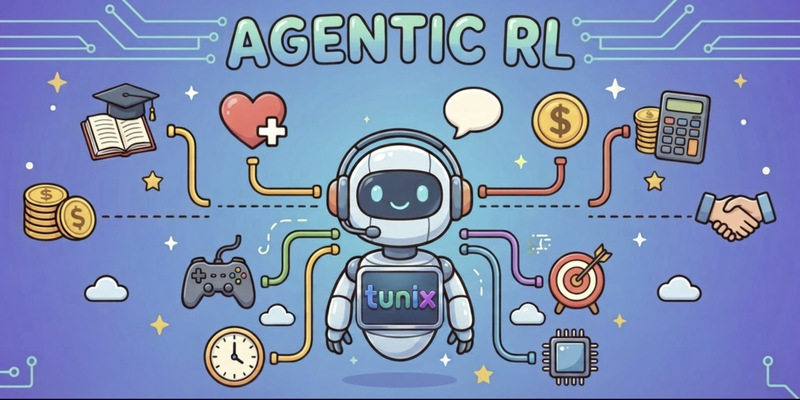
Tunix is Google’s new JAX-native post-training library designed to eliminate TPU idling bottlenecks when training multi-turn, tool-using LLM reasoning agents. It maximizes hardware throughput by combining highly concurrent, asynchronous rollouts with a decoupled producer-consumer pipeline, ensuring the trainer is constantly fed even while agents wait on network I/O or environment steps. Additionally, Tunix provides plug-and-play abstractions and continuous macro-level profiling, allowing developers to easily integrate custom open-source environments and optimize complex distributed workflows without massive code rewrites.
JULY 16, 2026 / AI
Google Cloud has partnered with Parallel Web Systems to natively integrate Parallel's search infrastructure as a web grounding provider on the Gemini Enterprise Agent Platform. This integration enables developers to anchor their AI agents in verifiable, real-time web results, significantly improving factual accuracy for complex enterprise workflows. Additionally, the partnership offers expanded architectural flexibility, allowing users to programmatically extract, permanently cache, and process web data alongside other large language models.

JULY 8, 2026 / Mobile
On May 23, 2026, fresh off the stage at Google I/O, our Google Developer Experts (GDEs) converged on...

JULY 6, 2026 / AI
Distributed AI training is notoriously fragile because losing a single machine typically crashes the entire multi-node job, forcing a time-consuming, full-workload infrastructure restart. To address this, Google’s JAX ecosystem utilizes elastic training via Pathways, which converts a hardware failure into a catchable Python exception so the running process can survive. When an unplanned failure occurs, the system automatically replaces only the broken worker, restores the last viable checkpoint from Cloud Storage, and resumes training in place—minimizing total downtime to under two minutes without ever restarting the main controller process.

JULY 1, 2026 / AI
Answering the questions of "why we built ADK 2.0". This explains the rationale, some of the features, and why a developer should consider upgrading. This will be published the day after ADK go 2.0 launches.

JULY 1, 2026 / AI
The Google Cloud Workbench Notebooks extension for VS Code has officially launched, allowing developers to connect their local IDE to scalable, cloud-based Jupyter environments. This integration streamlines the machine learning lifecycle by eliminating context switching and providing direct access to high-performance Google Cloud infrastructure. To support transparency and community-driven innovation, the newly released extension is fully open-sourced and available on GitHub and the VS Code Marketplace.

JUNE 30, 2026 / AI
Building AI agents often leaves developers uncertain if prompt tweaks to fix single errors will accidentally cause widespread regressions in production. To bridge this gap, Google has introduced a new developer skill for coding agents that automates a five-stage evaluation flywheel: preparing data, running inference, grading with adaptive AutoRaters, analyzing failure clusters, and executing targeted optimizations. Running continuously against production traffic or on-demand via synthetic scenarios, this tool allows developers to describe testing goals in plain language while an independent evaluation service safely validates and counts actual performance improvements.

JUNE 30, 2026 / AI
The Agent Development Kit (ADK) for Go 2.0 has been released, introducing a first-class, graph-based workflow engine to help developers compose complex, multi-agent applications. This update adds built-in primitives for human-in-the-loop (HITL) orchestration, dynamic execution using plain Go code, and automated resilience features like exponential backoff retries. By unifying the execution model, both single-agent applications and intricate graphs now run on the same runtime, simplifying telemetry and state persistence.

JUNE 22, 2026 / AI
How a Python agent and a Go agent collaborate on contract compliance using the Agent2Agent protocolY...
