
13 results
NOV. 17, 2026 / Mobile
Meet Another Build File Service (ABFS), Google's open-source content-addressable filesystem and build cache that cuts Android checkouts to <8s and builds to ~2m.
NOV. 17, 2026 / Web
Google AI Studio now lets developers build, test, and ship full-stack Kotlin Android apps from a single prompt—complete with Cloud Firestore, Firebase Authentication, Firebase AI Logic, a faster HD emulator with audio, visual screenshot debugging, and direct publishing to your personal Google Play library.

NOV. 17, 2026 / AI
Google's Gemini 4 Hydrogen brings strong spatial and embodied reasoning capabilities to a fast, efficient model built specifically for robotics. To help developers put these capabilities to work, the new Robotics plugin for Google Antigravity transforms the platform into a comprehensive workbench supporting rapid hardware bring-up, MuJoCo simulation, and closed-loop control. Developers can leverage these tools to transition from an unboxed robot arm to a fully functional real-to-sim-to-real application in an afternoon using natural language prompts and day-one support in the google-genai SDKs.
NOV. 16, 2026 / AI
AI agent sessions remain active and idle for most of the workday, making traditional one-Pod-per-session allocations inefficient for cluster resources. By using open-source tools like Agent Substrate and AX on GKE, developers can park idle sessions in object storage to release compute resources while maintaining session state. This approach optimizes resource utilization and reduces Kubernetes node costs by up to 40%.

NOV. 16, 2026 / AI
How we eliminated floating-point train–inference logprob drift for on-policy LLM reinforcement learning across 64 Cloud TPU v5p chips using a generalizable four-part JAX and Pallas recipe in Tunix.

NOV. 16, 2026 / AI
The newly launched AI-Hypercomputer/tpu-codesign guide provides hardware-grounded design rules to help developers maximize performance on TPUs for LLMs and Mixture-of-Experts (MoE) workloads. Key principles include aligning reduction and output dimensions to 256 for systolic arrays, adopting LatentMoE to compress routed token traffic, and mapping parallel axes directly onto physical links.

NOV. 12, 2026 / AI
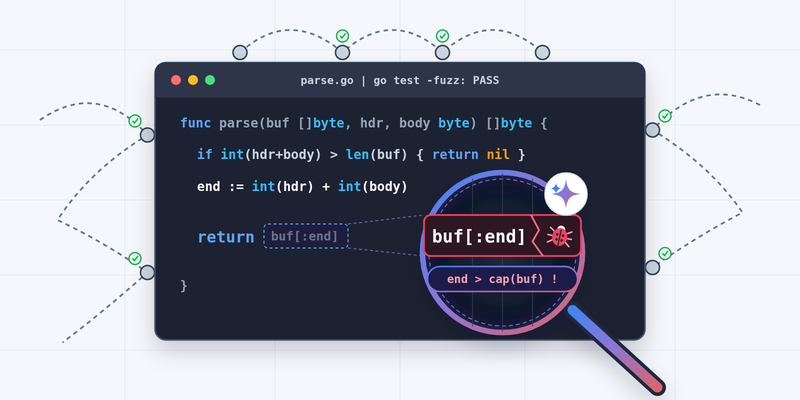
How pairing Go's surviving compiler bounds-check traps with Gemini 4 Argon and the Z3 constraint solver catches latent out-of-bounds panics in Go code and uncovers a slice-capacity blind spot in go test -fuzz.
NOV. 11, 2026 / Mobile
A2UI 1.0 is an open protocol for generative UI that enables AI agents to render interactive, native screens across web, mobile, and desktop applications. Developers can leverage open-source renderer SDKs—including React, Angular, Lit, Flutter, SwiftUI, and Jetpack Compose—alongside agent SDKs for Python, TypeScript, and Dart. The release introduces bidirectional function calls, swappable inference formats, and secure data binding to help teams seamlessly integrate generative UI into their product stacks.

OCT. 29, 2026 / Mobile
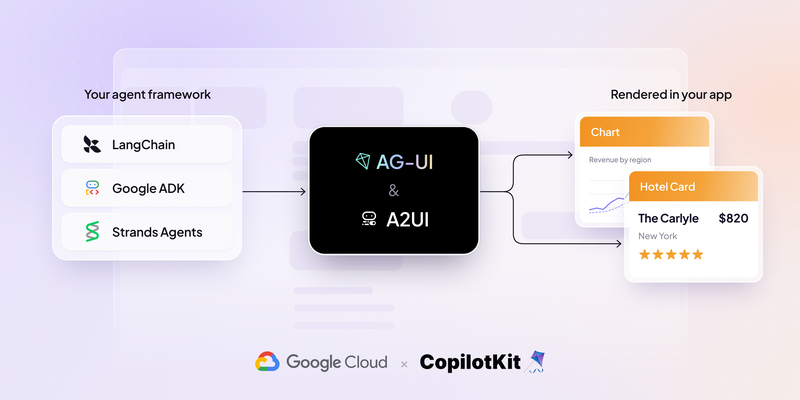
See Google A2Ui in action! Learn how to natively render agentic UIs across Langchain, AWS Strands, Microsoft agents, and Google ADK using CopilotKit SDKs for A2UI.
OCT. 27, 2026 / Mobile
This document provides a publication template and metadata structure for a technical blog post focused on building Conversational User Interfaces (CUIs) using AI. It outlines key developer focus areas, product stacks, and approval workflows required for publishing technical content through Google Developer Studio. The framework helps engineers organize their guides and solutions to effectively share AI-driven conversational interface designs with the developer community.
