
105 results
OCT. 15, 2026 / AI
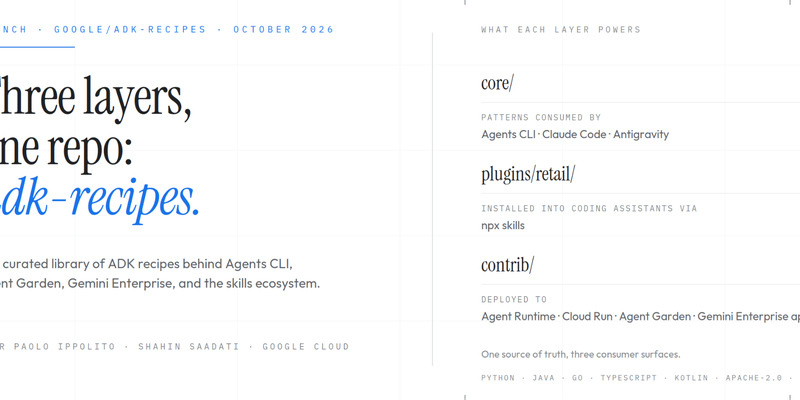
The google/adk-recipes repository unifies Agent Development Kit (ADK) resources into three structured layers—core/, plugins/, and contrib/—serving as a single source of truth for building AI agents. Developers can leverage reference patterns, install modular vertical skills (such as retail product search and virtual try-on) directly into their coding assistants, and deploy production-ready services across multiple languages. This cohesive structure streamlines the entire workflow from initial scaffolding to full deployment on Google Cloud infrastructure.
OCT. 15, 2026 / AI
A practical engineering guide and reference architecture for establishing continuous evaluation pipelines for multi-turn AI agents using Gemini Enterprise Agent Platform, Google ADK, and OpenInference standards.

OCT. 15, 2026 / Mobile
Google OAuth Platform now supports DPoP (Demonstrating Proof-of-Possession) to sender-constrain refresh tokens, neutralizing Infostealer malware and adversary-in-the-middle attacks. By cryptographically binding long-lived refresh tokens while maintaining short-lived access tokens as standard Bearer tokens, developers achieve robust credential security without incurring high-QPS API performance overhead. Additionally, developers integrating multi-agent or Model Context Protocol (MCP) workloads can use Google Cloud Secure Token Service (STS) to handle secure token delegation across agent chains.

OCT. 14, 2026 / AI
Apigee hybrid 1.17.0 introduces native Model Context Protocol (MCP) support, enabling the MCP data plane to run directly within your own Kubernetes cluster. This architecture ensures that AI agent request traffic and tool execution remain entirely inside your infrastructure while pulling configuration updates from the control plane. Developers can expose OpenAPI 3.0.x specifications as discoverable MCP tools, leverage existing security policies and API products, and trace end-to-end requests using W3C trace context headers.

OCT. 8, 2026 / AI
How do you keep improving an AI agent after the first 80%, once it serves real production traffic and silent quality regressions return HTTP 200 OK? We are open-sourcing AQuA (Ambient Quality Agent), a reference implementation that runs beside your production agent in Google Cloud, sweeps and verifies failure clusters against conversation transcripts, and diagnoses root causes anchored to the exact deployed source snapshot.

OCT. 8, 2026 / Mobile
Google AI Edge has introduced ML Drift, a high-performance, universal GPU compute framework designed to accelerate on-device AI and machine learning inference. By abstracting the complexities of hardware and low-level APIs—including OpenGL ES, OpenCL, Metal, and WebGPU—ML Drift enables developers to build real-time, interactive ML experiences, from sophisticated video effects to generative AI, across mobile and desktop platforms.

OCT. 7, 2026 / AI
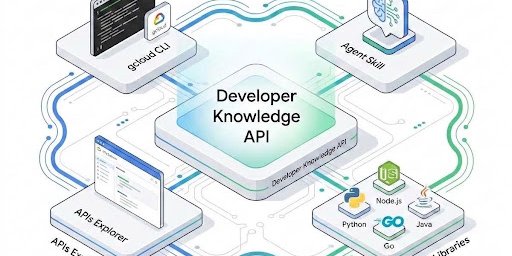
Google is launching the Developer Knowledge API and MCP Server in public preview. This new toolset provides a canonical, machine-readable way for AI assistants and agentic platforms to search and retrieve up-to-date documentation across Firebase, Google Cloud, Android, and more. By using the official MCP server, developers can connect tools directly to Google’s documentation corpus, ensuring that AI-generated code and guidance are based on authoritative, real-time context.
SEPT. 23, 2026 / AI
The Google Antigravity SDK now empowers developers to execute offline, agentic workflows locally using models like Gemma 4 26B A4B via LiteRT. This update facilitates powerful hybrid orchestration architectures, allowing a cloud model to act as a lightweight planner while local models securely handle token-intensive tasks—like code auditing and patching—directly on-device. Furthermore, the SDK provides drop-in support for OpenAI-compatible inference servers like Ollama and vLLM, enabling the seamless creation of privacy-first, autonomous local utilities.
SEPT. 17, 2026 / AI
Google has partnered with Speakeasy to open-source their OpenAPI code generation suite under the AGPLv3 license, a strategic move prompted by the sudden shutdown of Google's previous proprietary SDK provider. The newly open-sourced suite equips developers with deterministic, multi-language SDK generators that natively support strict typing and SSE streaming, alongside tools for compiling agent-native CLIs and documentation MCP servers. Engineering teams can now safely integrate this robust tooling directly into their CI pipelines to automatically generate reliable client libraries for their own APIs, all while retaining complete licensing control over the output code.
SEPT. 11, 2026 / AI
The "autofinetune" project introduces an autonomous research loop that fully automates LLM post-training workflows, including Supervised Fine-Tuning (SFT) and Reinforcement Learning via GRPO. By defining boundary conditions and evaluation metrics in a single Markdown specification, developers can deploy an AI agent to iteratively edit training scripts, launch experiments, and automatically commit verified hyperparameter optimizations to Git. Built on Google’s AI stack—including Tunix, Gemma, and Cloud TPUs—this framework eliminates manual tuning cycles, successfully demonstrating hands-off performance gains in both function calling and math reasoning models.
