
141 results
OCT. 6, 2026 / AI
EmbeddingGemma 2 is a compact, open-source multimodal embedding model that maps text, code, images, video, and audio into a unified 768-dimensional space. Developers can use the sentence-transformers library to selectively load modular modality encoders—ranging from 270M to 740M parameters—to optimize memory usage. Additionally, Matryoshka Representation Learning enables dynamic dimension truncation down to 128d, significantly reducing vector database storage requirements while maintaining high retrieval performance.
SEPT. 23, 2026 / AI
The Google Antigravity SDK now empowers developers to execute offline, agentic workflows locally using models like Gemma 4 26B A4B via LiteRT. This update facilitates powerful hybrid orchestration architectures, allowing a cloud model to act as a lightweight planner while local models securely handle token-intensive tasks—like code auditing and patching—directly on-device. Furthermore, the SDK provides drop-in support for OpenAI-compatible inference servers like Ollama and vLLM, enabling the seamless creation of privacy-first, autonomous local utilities.
SEPT. 17, 2026 / AI
Google has partnered with Speakeasy to open-source their OpenAPI code generation suite under the AGPLv3 license, a strategic move prompted by the sudden shutdown of Google's previous proprietary SDK provider. The newly open-sourced suite equips developers with deterministic, multi-language SDK generators that natively support strict typing and SSE streaming, alongside tools for compiling agent-native CLIs and documentation MCP servers. Engineering teams can now safely integrate this robust tooling directly into their CI pipelines to automatically generate reliable client libraries for their own APIs, all while retaining complete licensing control over the output code.
SEPT. 16, 2026 / AI
Agent Anomaly Detection is a new, out-of-band oversight layer for the Gemini Enterprise Agent Platform that analyzes OpenTelemetry traces and tool calls to catch behavioral risks without adding runtime latency to live requests. It utilizes a multi-tiered detection pipeline—combining lightweight statistical scanning with deep LLM-based reasoning—to identify logical anomalies and policy violations grounded in the OWASP Agentic Top 10. Developers can triage these automated findings within Security Command Center or leverage the exposed API to programmatically block subsequent tool calls when an agent breaches defined risk thresholds.

SEPT. 15, 2026 / AI
This blog post explores how to transition AI agents from static, build-time security controls to dynamic runtime governance using the Gemini Enterprise Agent Platform. It highlights three primary managed defenses: Model Armor for screening edge prompts, Semantic Governance Policies for evaluating tool intent against business rules, and Agent Anomaly Detection for catching multi-turn exploits. By shifting these capabilities to the platform level, security administrators can dynamically enforce policies and neutralize complex attacks without needing to modify or redeploy the agent's underlying code.

SEPT. 11, 2026 / AI
The "autofinetune" project introduces an autonomous research loop that fully automates LLM post-training workflows, including Supervised Fine-Tuning (SFT) and Reinforcement Learning via GRPO. By defining boundary conditions and evaluation metrics in a single Markdown specification, developers can deploy an AI agent to iteratively edit training scripts, launch experiments, and automatically commit verified hyperparameter optimizations to Git. Built on Google’s AI stack—including Tunix, Gemma, and Cloud TPUs—this framework eliminates manual tuning cycles, successfully demonstrating hands-off performance gains in both function calling and math reasoning models.

SEPT. 9, 2026 / AI
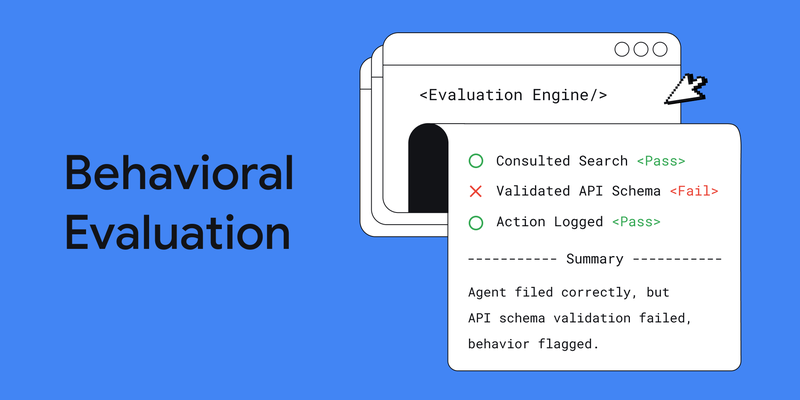
While end-to-end benchmarks like SWE-bench provide broad performance scores for AI agents, they are often expensive, slow, and lack the root-cause diagnostics needed to explain exactly where an agent's logic broke down. To solve this, developers should adopt behavioral evaluations—fast, local, unit-style tests that assert on discrete intermediate actions, such as verifying specific tool calls or file modifications rather than final string equality. By building these inexpensive micro-checks alongside macro benchmarks, engineering teams can confidently iterate on system prompts and upgrade models without the risk of regressions.
SEPT. 9, 2026 / Mobile
Google has officially released version 1.0 of the Agent Development Kit (ADK) for Kotlin, achieving full feature parity with the Python and Java ADK cores to enable idiomatic, multi-agent AI development. Built on Kotlin Multiplatform (KMP), the framework leverages Kotlin Symbol Processing (KSP) for zero-reflection, type-safe function calling, alongside advanced orchestration capabilities like human-in-the-loop workflows and context compaction. Additionally, the release introduces a robust suite of Android-first extensions, allowing mobile developers to integrate local models via LiteRT-LM, cloud reasoning through Firebase AI, session persistence using Room, and semantic memory powered by AppSearch.

SEPT. 4, 2026 / AI
The Gemini Enterprise Developer Experience (DevEx) program conducts ongoing sprint testing of end-to-end developer workflows to identify and rapidly resolve friction points without relying on internal shortcuts. This recent sprint focused on optimizing enterprise AI governance, including refining setup prerequisites, securing extension configurations, and clarifying policy enforcement mechanics to ensure a smoother, more reliable deployment. Developers can now leverage updated documentation and standardized code samples to improve their experience with Agent Gateway and Semantic Governance configurations.

SEPT. 2, 2026 / AI
The recent Google for Startups AI Agents Challenge revealed that the most successful multi-agent systems rely on foundational software engineering patterns rather than just raw model power. Winning architectures consistently implemented bidirectional MCP for seamless inter-agent communication, async event buses for parallel execution, strict unified validation for model fallbacks, and tiered routing to minimize expensive inference calls. By prioritizing these structural practices over simple linear prompt chains, developers can build more resilient, low-latency, and cost-effective agentic workflows.
