48 results
AUG. 3, 2026 / AI
Real-time AI agents break traditional request-response load balancing paradigms because they rely on long-lived, stateful bidirectional streams that obscure true server capacity. To solve this, developers must implement application-level session tracking directly within the runtime to accurately measure the committed concurrent workload of active conversations. By feeding these precise session counts alongside standard CPU utilization metrics into a hybrid routing algorithm, infrastructure can effectively distribute stateful AI traffic and prevent individual backend bottlenecks.

JULY 21, 2026 / AI
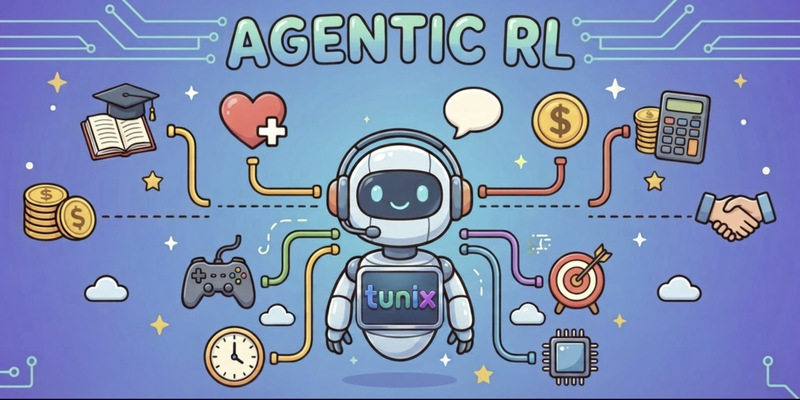
Tunix is Google’s new JAX-native post-training library designed to eliminate TPU idling bottlenecks when training multi-turn, tool-using LLM reasoning agents. It maximizes hardware throughput by combining highly concurrent, asynchronous rollouts with a decoupled producer-consumer pipeline, ensuring the trainer is constantly fed even while agents wait on network I/O or environment steps. Additionally, Tunix provides plug-and-play abstractions and continuous macro-level profiling, allowing developers to easily integrate custom open-source environments and optimize complex distributed workflows without massive code rewrites.
JULY 16, 2026 / AI
To resolve the scaling bottlenecks and runtime errors caused by monolithic system prompts, engineering teams should treat prompts as build artifacts by modularizing instructions into reusable templates. By running these modular "skill files" through a transpiler, developers can enforce static validation, catch missing dependencies at build time, and integrate prompt generation directly into their CI/CD pipelines. This deterministic approach prevents code drift and ultimately establishes a safe framework where agents can propose updates to their own logic via standard pull requests.
JULY 1, 2026 / AI
Answering the questions of "why we built ADK 2.0". This explains the rationale, some of the features, and why a developer should consider upgrading. This will be published the day after ADK go 2.0 launches.

MAY 19, 2026 / Mobile
Google AI Edge’s LiteRT-LM provides a production-proven, highly optimized infrastructure for running Gemma 4 across cross-platform mobile and edge environments. It actively unlocks the model's native multimodal and agentic features on-device by utilizing memory-efficient dynamic loading, Multi-Token Prediction for up to a 2.2x speedup, and advanced orchestration tools like Thinking Mode and Constrained Decoding. Furthermore, the engine is rapidly expanding its integration surfaces beyond Android, introducing new native Swift APIs for Apple ecosystems and WebGPU-accelerated JavaScript APIs for high-performance, serverless browser inference.

FEB. 19, 2026 / Gemini
The Android XR team is using Gemini's Canvas feature to make creating immersive extended reality (XR) experiences more accessible. This allows developers to rapidly prototype interactive 3D environments and models on a Samsung Galaxy XR headset using simple creative prompts.

DEC. 8, 2025 / Mobile
LiteRT and MediaTek are announcing the new LiteRT NeuroPilot Accelerator. This is a ground-up successor for the TFLite NeuroPilot delegate, bringing seamless deployment experience, state-of-the-art LLM support, and advanced performance to millions of devices worldwide.
DEC. 4, 2025 / AI
ADK introduces **Context Engineering** to scale AI agents beyond large context windows. It treats context as a compiled view over a tiered, stateful system (**Session, Memory, Artifacts**). This architecture uses explicit processors for transformation, enables efficient compaction and caching, and allows for strict, scoped context handoffs in multi-agent workflows to ensure reliability and cost-effectiveness in production.
NOV. 24, 2025 / Mobile
LiteRT's new Qualcomm AI Engine Direct (QNN) Accelerator unlocks dedicated NPU power for on-device GenAI on Android. It offers a unified mobile deployment workflow, SOTA performance (up to 100x speedup over CPU), and full model delegation. This enables smooth, real-time AI experiences, with FastVLM-0.5B achieving over 11,000 tokens/sec prefill on Snapdragon 8 Elite Gen 5 NPU.
OCT. 30, 2025 / AI
The blog post argues the request-response model fails for advanced multi-agent AI. It advocates for a real-time bidirectional streaming architecture, implemented by the Agent Development Kit (ADK). This streaming model enables true concurrency, natural interruptibility, and unified multimodal processing. ADK's core features are real-time I/O management, stateful sessions for agent handoffs, and streaming-native tools.