
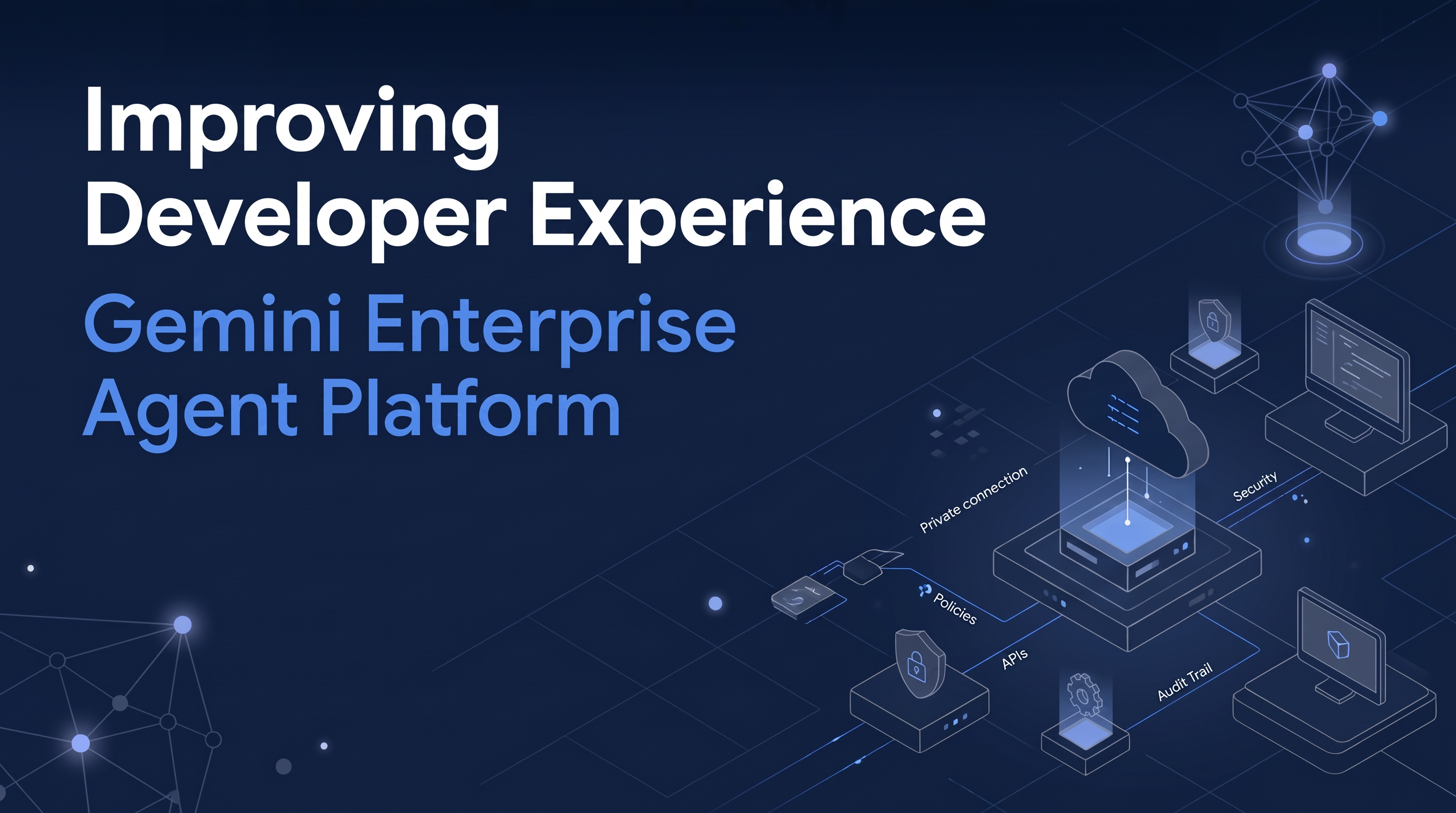
At Google Cloud, we believe building enterprise-grade AI solutions requires more than just powerful models: it requires a seamless platform that works end-to-end for all developers. This is the core mission of the Gemini Enterprise developer experience (DevEx) Program.
This ongoing initiative is dedicated to pressure-testing our own tools exactly as a developer experiences them. The methodology is powerful and straightforward: With each sprint, our team walks a fixed set of developer workflows without the use of internal credentials or shortcuts. We document every point of friction that a developer would encounter, and work directly with engineering to deliver rapid, systemic improvements. Finding friction is only half the loop; closing it fast is the other half. For you, this means a more intuitive, reliable, and secure experience where the building components just work.
Governance is the backbone of enterprise AI because it allows agents to operate more securely, predictably, and compliantly. To deliver the most value, our DevEx team has focused on governance in this sprint and mapped out a core end-to-end path for it on Gemini Enterprise. Our testing covers these workflows in strict dependency order:
Through user-journey testing in this sprint, we identified and resolved friction points with documentation and integration across our agent governance products. The key friction points we resolved include:
api.getAttribute() format to smoothen the process of successful custom policy compilation.Our work doesn't stop when a ticket is closed. As part of our DevEx loop we ensure the friction logging process aligns very closely to how developers use our products, and every fix is rigorously re-verified to ensure the platform actually works end-to-end for you. If you are facing friction with using the products and would like to either receive support or report issues you can read more on the various options available to you here.
We are committed to continuously walking these journeys to expose hidden traps and resolve the friction points that slow you down. Through this constant iteration, our goal is to keep pushing Gemini Enterprise toward a seamless, secure, and frictionless future. Give governance on Gemini Enterprise Agent Platform a try today to experience these benefits firsthand, and stay tuned for our next sprint update!
We'd like to extend a special thanks to the following contributors for their work on this program: Richa Thapa Magar, Sammy Krieger, Benazir Fateh, Elliot Yamaguchi, Eliza Kuzamenko, Evelyn Camacho Sobero, Ambreen Kazi, Bobby Power, Su-Lyn Rosenberry, Shubham Saboo, Dave Eliott and Donna Schut.

Announcing MCP support in Apigee hybrid: agentic tools that run in your own cluster

Reproducing Olmo 3 7B Pre-training in MaxText: case study of large scale training on TPUs

Gemini 4 Argon for Robotics

Autonomous LLM post-training with Tunix on TPUs