
196 results
OCT. 27, 2026 / Mobile
This document provides a publication template and metadata structure for a technical blog post focused on building Conversational User Interfaces (CUIs) using AI. It outlines key developer focus areas, product stacks, and approval workflows required for publishing technical content through Google Developer Studio. The framework helps engineers organize their guides and solutions to effectively share AI-driven conversational interface designs with the developer community.

OCT. 22, 2026 / Cloud
API Gateway now supports real-time streaming—including Server-Sent Events, WebSockets, gRPC, and chunked transfer encoding—in Public Preview without requiring changes to your existing API specifications. This update allows developers to route long-lived, bi-directional streams and AI workloads directly through the gateway while maintaining consistent authentication, rate limiting, and observability. Additionally, gateways now feature deterministic default hostnames, simplifying environment provisioning and infrastructure-as-code management.
OCT. 22, 2026 / AI
Learn how Project Chrysalis combines Google Cloud's Gemini Enterprise Agent Platform, Agent Development Kit (ADK), BigQuery, and a four-gate defense-in-depth security stack (Model Armor, Cloud KMS, Binary Authorization, and OPA) to build governed, self-evolving AI agents that remediate live production outages in 1.8 seconds.

OCT. 21, 2026 / AI
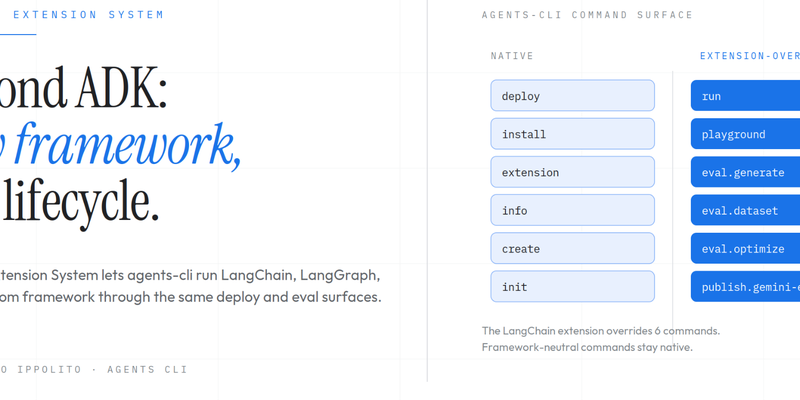
The Agents CLI Extension System enables developers to use frameworks like LangChain, LangGraph, or custom enterprise stacks while retaining a unified deployment and evaluation workflow. It details a first-party LangChain template that scaffolds, runs, and deploys agents without requiring the Agent Development Kit (ADK). Additionally, it demonstrates how platform teams can author custom extensions to enforce policies such as automated software bill of materials (SBOM) scans during deployment.
OCT. 19, 2026 / AI
The open-source Agent Development Kit (ADK) and gemini-3.8-live enable developers to build responsive voice agents by implementing non-blocking tools in Python. Developers can use streaming tools to yield progress updates or background execution patterns to keep conversations fluid during long-running backend queries. Additionally, configuring response scheduling behaviors such as WHEN_IDLE, INTERRUPT, or SILENT gives developers precise control over when and how tool results are delivered into the conversation.

OCT. 15, 2026 / AI
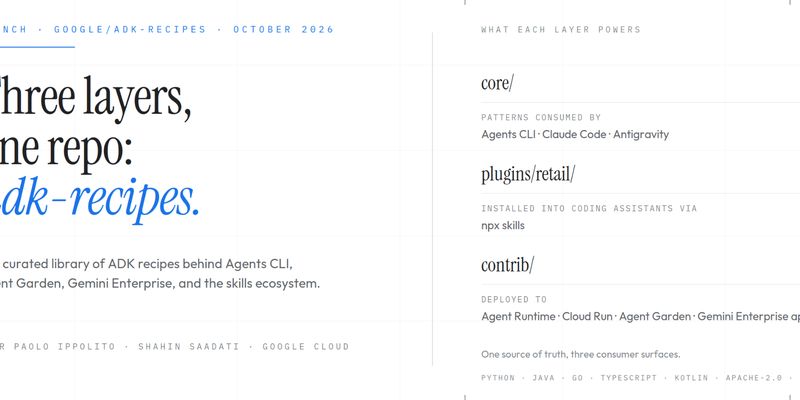
The google/adk-recipes repository unifies Agent Development Kit (ADK) resources into three structured layers—core/, plugins/, and contrib/—serving as a single source of truth for building AI agents. Developers can leverage reference patterns, install modular vertical skills (such as retail product search and virtual try-on) directly into their coding assistants, and deploy production-ready services across multiple languages. This cohesive structure streamlines the entire workflow from initial scaffolding to full deployment on Google Cloud infrastructure.
OCT. 15, 2026 / AI
A practical engineering guide and reference architecture for establishing continuous evaluation pipelines for multi-turn AI agents using Gemini Enterprise Agent Platform, Google ADK, and OpenInference standards.

OCT. 15, 2026 / Mobile
Google OAuth Platform now supports DPoP (Demonstrating Proof-of-Possession) to sender-constrain refresh tokens, neutralizing Infostealer malware and adversary-in-the-middle attacks. By cryptographically binding long-lived refresh tokens while maintaining short-lived access tokens as standard Bearer tokens, developers achieve robust credential security without incurring high-QPS API performance overhead. Additionally, developers integrating multi-agent or Model Context Protocol (MCP) workloads can use Google Cloud Secure Token Service (STS) to handle secure token delegation across agent chains.

OCT. 13, 2026 / AI
Gemini 4 Argon is a general-purpose physical reasoning model designed to enhance workflows across the robotics stack with advanced capabilities in physical understanding, code generation, and visual-semantic reasoning. Developers can access and integrate Argon across Google's developer platforms—including Google AI Studio, the Gemini API, and Google Antigravity—to build and test sophisticated robotic applications. By leveraging simulation tools like MuJoCo and code-as-policies, engineers can seamlessly transition from real-world data or sketches to physically verified robot control and self-improvement workflows.
OCT. 13, 2026 / Gemini
How our engineering team ran Gemini 4 Argon unattended overnight with .agents/skills and /goal mode to cut in-memory session prep overhead by 40% in long sessions and speed up cold imports by 21% in Google's open-source Python Agent Development Kit (ADK).
