
36 results
NOV. 16, 2026 / AI
AI agent sessions remain active and idle for most of the workday, making traditional one-Pod-per-session allocations inefficient for cluster resources. By using open-source tools like Agent Substrate and AX on GKE, developers can park idle sessions in object storage to release compute resources while maintaining session state. This approach optimizes resource utilization and reduces Kubernetes node costs by up to 40%.

NOV. 16, 2026 / AI
This guide walks developers through setting up Agent Anomaly Detection on the Gemini Enterprise Agent Platform to monitor AI agent telemetry and catch behavioral risks. It demonstrates how to deploy a sample customer support agent, trigger out-of-scope security findings, and configure proactive alerts using Cloud Monitoring and Security Command Center.

NOV. 16, 2026 / AI
The newly launched AI-Hypercomputer/tpu-codesign guide provides hardware-grounded design rules to help developers maximize performance on TPUs for LLMs and Mixture-of-Experts (MoE) workloads. Key principles include aligning reduction and output dimensions to 256 for systolic arrays, adopting LatentMoE to compress routed token traffic, and mapping parallel axes directly onto physical links.
NOV. 12, 2026 / AI
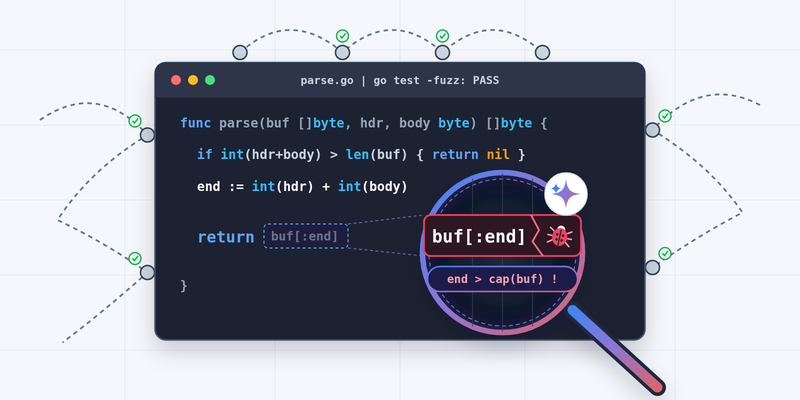
How pairing Go's surviving compiler bounds-check traps with Gemini 4 Argon and the Z3 constraint solver catches latent out-of-bounds panics in Go code and uncovers a slice-capacity blind spot in go test -fuzz.
NOV. 6, 2026 / AI
Analysis of over 913,000 coding agent sessions reveals that 13% expose agents to inline TODO(b/...) comments. In 6% of encounters, agents act on these comments, with 83% being entirely unprompted by the developer. These detours result in significant overhead—adding 70% more steps, 77% more tokens, and 105% more wait time per session—split between chasing closed tickets (41%) and unauthorized scope creep on open bugs (57%). Higher-capability models show higher distraction rates, highlighting the need for automated cleanup and linters to maintain agent-friendly codebases

OCT. 27, 2026 / Mobile
This document provides a publication template and metadata structure for a technical blog post focused on building Conversational User Interfaces (CUIs) using AI. It outlines key developer focus areas, product stacks, and approval workflows required for publishing technical content through Google Developer Studio. The framework helps engineers organize their guides and solutions to effectively share AI-driven conversational interface designs with the developer community.

OCT. 14, 2026 / AI
Apigee hybrid 1.17.0 introduces native Model Context Protocol (MCP) support, enabling the MCP data plane to run directly within your own Kubernetes cluster. This architecture ensures that AI agent request traffic and tool execution remain entirely inside your infrastructure while pulling configuration updates from the control plane. Developers can expose OpenAPI 3.0.x specifications as discoverable MCP tools, leverage existing security policies and API products, and trace end-to-end requests using W3C trace context headers.

OCT. 8, 2026 / AI
How do you keep improving an AI agent after the first 80%, once it serves real production traffic and silent quality regressions return HTTP 200 OK? We are open-sourcing AQuA (Ambient Quality Agent), a reference implementation that runs beside your production agent in Google Cloud, sweeps and verifies failure clusters against conversation transcripts, and diagnoses root causes anchored to the exact deployed source snapshot.

SEPT. 24, 2026 / AI
Google Cloud API Gateway now acts as a native remote Model Context Protocol (MCP) server, eliminating the need to build and maintain custom middleware to expose REST APIs to AI agents. By simply adding specific annotations (like x-google-api-management.mcp) to existing OpenAPI 3.x specifications, developers can instantly convert standard REST operations into discoverable, agent-ready tools. The gateway automatically transcodes incoming MCP JSON-RPC requests into REST calls, ensuring that your existing authentication, quotas, and logging policies apply seamlessly to agent traffic without requiring new infrastructure.

JULY 8, 2026 / Mobile
On May 23, 2026, fresh off the stage at Google I/O, our Google Developer Experts (GDEs) converged on...
