
554 results
OCT. 27, 2026 / Mobile
This document provides a publication template and metadata structure for a technical blog post focused on building Conversational User Interfaces (CUIs) using AI. It outlines key developer focus areas, product stacks, and approval workflows required for publishing technical content through Google Developer Studio. The framework helps engineers organize their guides and solutions to effectively share AI-driven conversational interface designs with the developer community.

OCT. 27, 2026 / Mobile
A2UI now supports swappable inference formats, introducing A2UI Express which uses up to 3x fewer tokens and cuts latency by compiling compact Python-style syntax into standard A2UI JSON via Agent SDKs. Developers can also use controlled generation with TypeSafe's Jev system-decision models to render known-shape screens in under 300 ms while smaller models stream text. These updates require no changes to frontend renderers or component catalogs, offering flexible performance levers for generative UI development across Python, TypeScript, and Dart.

OCT. 26, 2026 / Web
Google Workspace now offers native support for Markdown (.md) files, allowing developers and AI agents to seamlessly collaborate on documentation directly in Google Docs without manual file conversions. This integration preserves native file fidelity for use with Git repositories and developer tools while unlocking standard Docs features like line-level commenting, rendered Drive previews, and tracked version history.

OCT. 22, 2026 / Cloud
API Gateway now supports real-time streaming—including Server-Sent Events, WebSockets, gRPC, and chunked transfer encoding—in Public Preview without requiring changes to your existing API specifications. This update allows developers to route long-lived, bi-directional streams and AI workloads directly through the gateway while maintaining consistent authentication, rate limiting, and observability. Additionally, gateways now feature deterministic default hostnames, simplifying environment provisioning and infrastructure-as-code management.
OCT. 22, 2026 / AI
Learn how Project Chrysalis combines Google Cloud's Gemini Enterprise Agent Platform, Agent Development Kit (ADK), BigQuery, and a four-gate defense-in-depth security stack (Model Armor, Cloud KMS, Binary Authorization, and OPA) to build governed, self-evolving AI agents that remediate live production outages in 1.8 seconds.

OCT. 21, 2026 / AI
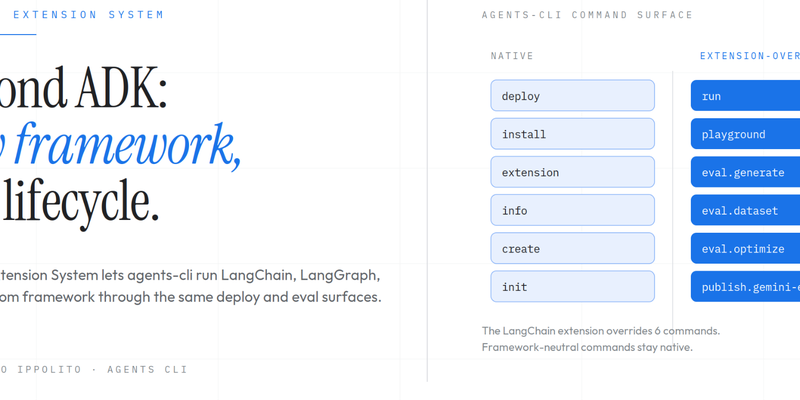
The Agents CLI Extension System enables developers to use frameworks like LangChain, LangGraph, or custom enterprise stacks while retaining a unified deployment and evaluation workflow. It details a first-party LangChain template that scaffolds, runs, and deploys agents without requiring the Agent Development Kit (ADK). Additionally, it demonstrates how platform teams can author custom extensions to enforce policies such as automated software bill of materials (SBOM) scans during deployment.
OCT. 20, 2026 / Mobile
Google AI Edge Model Explorer now supports custom compiler intermediate representations and open-source adapters like TOSA, VGF, and PTE for on-device machine learning. Developers can leverage hierarchical graph visualization, split-pane views, and per-node trace overlays to catch export regressions and verify hardware delegation. These tools enable engineering teams to transparently debug execution graphs and pinpoint cycle-level latency bottlenecks locally.

OCT. 20, 2026 / AI
TorchTPU integrates a native torch.device("tpu") backend directly into PyTorch, allowing developers to train large-scale models on Google Cloud TPUs without rewriting code in JAX. The TorchTitan TPU fork enhances this with production-grade scaling primitives like SimpleFSDP, Graph Trainer, and custom Pallas kernels that achieve high Model Flops Utilization (MFU) across dense and MoE architectures. Developers can leverage these battle-tested optimization playbooks, recipes, and the Hugging Face modeling backend to efficiently scale their own workloads on TPU infrastructure.

OCT. 20, 2026 / AI
This post announces native PyTorch backends for vLLM and SGLang powered by TorchTPU, enabling developers to run and optimize serving workloads using familiar PyTorch tools. Built in collaboration with open-source project maintainers, these engines include optimized TPU kernel implementations, production-ready features like KV cache management with TPU Sync, and disaggregated serving. Public benchmarks demonstrate state-of-the-art performance and industry-leading cost efficiency on Ironwood TPU across long-context and agentic workloads.

OCT. 20, 2026 / Mobile
Google Research has completed the 32-bit open-source Coral NPU RISC-V architecture with the introduction of its Matrix Execution Unit, which delivers up to 1 TOPS while targeting 10 mW average power for edge inference. Alongside this architecture, the release of the v1.0 open-source IREE/MLIR compiler allows developers to take models from JAX, PyTorch, and TensorFlow straight to Coral NPU hardware without writing custom assembly. Developers can now prototype and deploy these multimodal edge applications using new hardware options like the Synaptics Astra SR200 MCU series and globally available Coralboard devkits.12
