329 results
MAY 4, 2026 / AI
Researchers at UCSD have successfully implemented DFlash, a block-diffusion speculative decoding method, on Google TPUs to bypass the sequential bottlenecks of traditional autoregressive drafting. By "painting" entire blocks of candidate tokens in a single forward pass rather than predicting them one-by-one, the system achieved average speedups of 3.13x, with peak performance nearly doubling that of existing methods like EAGLE-3. This open-source integration into the vLLM ecosystem optimizes TPU hardware by leveraging "free" parallel verification and high-quality draft predictions for complex reasoning tasks.

APRIL 29, 2026 / Cloud
Google Cloud has introduced a high-performance integration that connects Rapid Storage directly to PyTorch via the fsspec interface to eliminate AI training bottlenecks. By utilizing Google’s Colossus architecture and bidirectional gRPC streaming, the solution offers up to 15 TiB/s aggregate throughput and significant reductions in latency. These improvements allow developers to speed up total training time by 23% with zero code changes required beyond updating the storage bucket type.

APRIL 23, 2026 / Mobile
LiteRT is a production-ready framework designed to help mobile developers unlock the power of Neural Processing Units (NPUs), overcoming the performance and battery limitations of traditional CPU or GPU processing. By providing a unified API that abstracts away hardware complexities, it allows industry leaders like Google Meet and Epic Games to deploy sophisticated AI models for real-time video, animation, and speech recognition with significantly higher efficiency. The platform further supports developers through benchmarking tools and cross-platform compatibility, enabling seamless AI deployment across mobile devices, AI PCs, and industrial IoT hardware.

APRIL 16, 2026 / AI
MaxText has introduced new support for Supervised Fine-Tuning (SFT) and Reinforcement Learning (RL) on single-host TPU configurations, leveraging JAX and the Tunix library for high-performance model refinement. These features enable developers to easily adapt pre-trained models for specialized tasks and complex reasoning using efficient algorithms like GRPO and GSPO. This update streamlines the post-training workflow, offering a scalable path from single-host setups to larger multi-host configurations.

APRIL 15, 2026 / AI
Gemini CLI has introduced subagents, specialized expert agents that handle complex or high-volume tasks in isolated context windows to keep the primary session fast and focused. These agents can be customized via Markdown files, run in parallel to boost productivity, and are easily invoked using the @agent syntax for targeted delegation. This architecture prevents "context rot" by consolidating intricate multi-step executions into concise summaries for the main orchestrator.

APRIL 7, 2026 / AI
TorchTPU is a new engineering stack designed to provide a native, high-performance experience for running PyTorch workloads on Google’s TPU infrastructure with minimal code changes. It features an "Eager First" approach with multiple execution modes and utilizes the XLA compiler to optimize distributed training across massive clusters. Moving into 2026, the project aims to further reduce compilation overhead and expand support for dynamic shapes and custom kernels to ensure seamless scalability for the next generation of AI.

APRIL 2, 2026 / Mobile
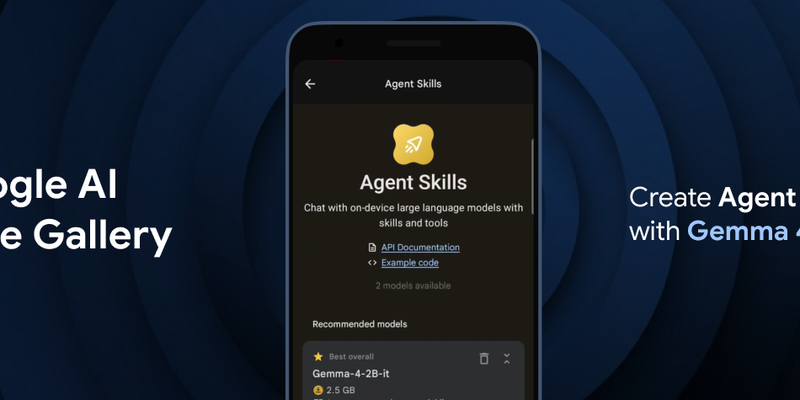
Google DeepMind has launched Gemma 4, a family of state-of-the-art open models designed to enable multi-step planning and autonomous agentic workflows directly on-device. The release includes the Google AI Edge Gallery for experimenting with "Agent Skills" and the LiteRT-LM library, which offers a significant speed boost and structured output for developers. Available under an Apache 2.0 license, Gemma 4 supports over 140 languages and is compatible with a wide range of hardware, including mobile devices, desktops, and IoT platforms like Raspberry Pi.
APRIL 2, 2026 / Web
Google has updated its account settings to allow U.S. users to change their @gmail.com usernames while keeping all existing account data and inboxes intact. For developers, this means that while old email addresses will remain active as aliases, apps that rely solely on email addresses for identification may face issues with account duplication or lost access. To ensure a seamless user experience, Google recommends migrating to the "subject ID" as the primary user identifier and allowing users to manually update their contact information within app settings.

APRIL 1, 2026 / AI
The Agent Development Kit (ADK) SkillToolset introduces a "progressive disclosure" architecture that allows AI agents to load domain expertise on demand, reducing token usage by up to 90% compared to traditional monolithic prompts. Through four distinct patterns—ranging from simple inline checklists to "skill factories" where agents write their own code—the system enables agents to dynamically expand their capabilities at runtime using the universal agentskills.io specification. This modular approach ensures that complex instructions and external resources are only accessed when relevant, creating a scalable and self-extending framework for modern AI development.

MARCH 31, 2026 / AI
The newly introduced continuous checkpointing feature in Orbax and MaxText is designed to optimize the balance between reliability and performance during model training, addressing issues with conventional fixed-frequency checkpointing. Unlike fixed intervals—which can either compromise reliability or bottleneck performance—continuous checkpointing maximizes I/O bandwidth and minimizes failure risk by asynchronously initiating a new save operation only after the previous one successfully completes. Benchmarks demonstrate that this approach significantly reduces checkpoint intervals and results in substantial resource conservation, especially in large-scale training jobs where mean-time-between-failure (MTBF) is short.