83 results
OCT. 19, 2026 / Mobile
Meet the LiteRT Tensor API: giving developers native C++ control over the model graph to unify end-to-end ML computations on heterogeneous edge hardware.

OCT. 15, 2026 / Mobile
Google OAuth Platform now supports DPoP (Demonstrating Proof-of-Possession) to sender-constrain refresh tokens, neutralizing Infostealer malware and adversary-in-the-middle attacks. By cryptographically binding long-lived refresh tokens while maintaining short-lived access tokens as standard Bearer tokens, developers achieve robust credential security without incurring high-QPS API performance overhead. Additionally, developers integrating multi-agent or Model Context Protocol (MCP) workloads can use Google Cloud Secure Token Service (STS) to handle secure token delegation across agent chains.

OCT. 8, 2026 / Mobile
Google AI Edge has introduced ML Drift, a high-performance, universal GPU compute framework designed to accelerate on-device AI and machine learning inference. By abstracting the complexities of hardware and low-level APIs—including OpenGL ES, OpenCL, Metal, and WebGPU—ML Drift enables developers to build real-time, interactive ML experiences, from sophisticated video effects to generative AI, across mobile and desktop platforms.

OCT. 6, 2026 / Mobile
EmbeddingGemma 2 is a new 740M open-weight multimodal model that maps text, images, video, and audio into a unified vector space for privacy-first, on-device retrieval. Developers can easily integrate these capabilities cross-platform using MediaPipe Tasks or optimize fine-grained performance across CPU, GPU, and NPU accelerators with LiteRT. The model enables ultra-low-latency local solutions like search-as-you-type media retrieval, keyframe video moments finding, and zero-shot intent routing.

AUG. 13, 2026 / Mobile
Credentio is a newly released, open-source C++ library from Google that allows developers to integrate high-performance, local-first validation of C2PA Content Credentials into their client and server applications. By processing assets entirely locally with a highly optimized memory footprint, the library delivers instant validation verdicts for multi-gigabyte media files without incurring cloud latency, bandwidth costs, or data privacy risks. The library currently features deep manifest parsing alongside configurable trust list integration, and is available now on Google Source with future plans to support full credential generation and embedding.

AUG. 11, 2026 / Web
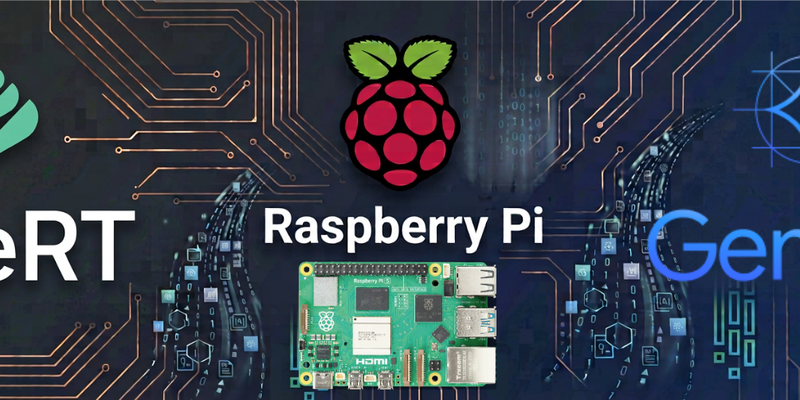
Deploying secure, real-time Edge AI on Raspberry Pi is now simplified using LiteRT and lightweight Gemma open models. LiteRT optimizes CPU and GPU performance, delivering fast token speeds for models like Gemma4, enabling real-time local reasoning for robotics. Developers can quickly convert, quantize, and run these models using the lightweight LiteRT CLI tool. Support for Hailo AI accelerators is also coming very soon.
JULY 9, 2026 / Web
We're excited to introduce LiteRT.js, the newest member of the LiteRT family! LiteRT.js is our powerful solution for running machine learning models directly in the browser, extending Google's cross-platform edge AI runtime to the web. Built for JavaScript developers, LiteRT.js delivers state-of-the-art ML model inference performance on WebGPU and upcoming WebNN, with a fallback to WebAssembly for CPU. This post provides a quick tour of LiteRT.js and gives web developers everything they need to get started.
JULY 8, 2026 / Mobile
On May 23, 2026, fresh off the stage at Google I/O, our Google Developer Experts (GDEs) converged on...

JUNE 22, 2026 / Web
AI coding agents are rapidly shifting from reactive assistants that complete tasks when prompted to ...

JUNE 17, 2026 / Web
This post introduces three architectural patterns designed to integrate Model Context Protocol (MCP) Apps and Agent-to-User Interface (A2UI) to solve the tradeoff between highly custom iframe environments and native, declarative rendering. By combining these approaches, developers can serve native-feeling UIs directly over MCP servers, embed complex and stateful iframe apps securely inside declarative views, or inject generative UI components into legacy systems. Ultimately, these hybrid frameworks empower engineering teams to deliver secure, performant, and brand-consistent agentic user experiences tailored to their specific project constraints.