31 results
OCT. 27, 2026 / Mobile
This document provides a publication template and metadata structure for a technical blog post focused on building Conversational User Interfaces (CUIs) using AI. It outlines key developer focus areas, product stacks, and approval workflows required for publishing technical content through Google Developer Studio. The framework helps engineers organize their guides and solutions to effectively share AI-driven conversational interface designs with the developer community.

OCT. 14, 2026 / AI
Apigee hybrid 1.17.0 introduces native Model Context Protocol (MCP) support, enabling the MCP data plane to run directly within your own Kubernetes cluster. This architecture ensures that AI agent request traffic and tool execution remain entirely inside your infrastructure while pulling configuration updates from the control plane. Developers can expose OpenAPI 3.0.x specifications as discoverable MCP tools, leverage existing security policies and API products, and trace end-to-end requests using W3C trace context headers.

OCT. 8, 2026 / AI
How do you keep improving an AI agent after the first 80%, once it serves real production traffic and silent quality regressions return HTTP 200 OK? We are open-sourcing AQuA (Ambient Quality Agent), a reference implementation that runs beside your production agent in Google Cloud, sweeps and verifies failure clusters against conversation transcripts, and diagnoses root causes anchored to the exact deployed source snapshot.

SEPT. 24, 2026 / AI
Google Cloud API Gateway now acts as a native remote Model Context Protocol (MCP) server, eliminating the need to build and maintain custom middleware to expose REST APIs to AI agents. By simply adding specific annotations (like x-google-api-management.mcp) to existing OpenAPI 3.x specifications, developers can instantly convert standard REST operations into discoverable, agent-ready tools. The gateway automatically transcodes incoming MCP JSON-RPC requests into REST calls, ensuring that your existing authentication, quotas, and logging policies apply seamlessly to agent traffic without requiring new infrastructure.

JULY 8, 2026 / Mobile
On May 23, 2026, fresh off the stage at Google I/O, our Google Developer Experts (GDEs) converged on...

JULY 1, 2026 / AI
The Google Cloud Workbench Notebooks extension for VS Code has officially launched, allowing developers to connect their local IDE to scalable, cloud-based Jupyter environments. This integration streamlines the machine learning lifecycle by eliminating context switching and providing direct access to high-performance Google Cloud infrastructure. To support transparency and community-driven innovation, the newly released extension is fully open-sourced and available on GitHub and the VS Code Marketplace.
MAY 28, 2026 / Pay
Google has announced the new Google Pay & Wallet Developer MCP server, an open-standard tool designed to securely connect AI development assistants and IDEs with real-time API and account context. The server allows developers to remain within their development environment to search official documentation, validate Wallet pass definitions, check integration status, and manage merchant accounts. Ultimately, this integration aims to reduce friction and accelerate development workflows by minimizing context switching and providing up-to-date, grounded AI support.

MARCH 31, 2026 / AI
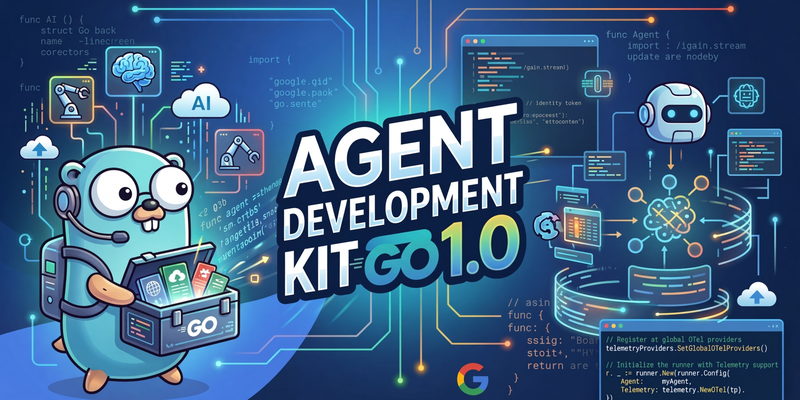
The launch of Agent Development Kit (ADK) for Go 1.0 marks a significant shift from experimental AI scripts to production-ready services by prioritizing observability, security, and extensibility. Key updates include native OpenTelemetry integration for deep tracing, a new plugin system for self-healing logic, and "Human-in-the-Loop" confirmations to ensure safety during sensitive operations. Additionally, the release introduces YAML-based configurations for rapid iteration and refined Agent2Agent (A2A) protocols to support seamless communication across different programming languages. This framework empowers developers to build complex, reliable multi-agent systems using the high-performance engineering standards of Golang.
FEB. 13, 2026 / AI
Conductor for the Gemini CLI has introduced a new Automated Review feature designed to verify the quality and accuracy of AI-generated code. This update addresses the challenge of validating agentic development by automatically checking implementations against original plans, enforcing style guides, and identifying security risks or bugs. by incorporating test-suite validation and providing actionable reports, Conductor helps developers ensure that their AI agents deliver safe, predictable, and architecturally sound code before it is finalized.
DEC. 17, 2025 / AI
Gemini 3 Flash is now available in Gemini CLI. It delivers Pro-grade coding performance with low latency and a lower cost, matching Gemini 3 Pro's SWE-bench Verified score of 76%. It significantly outperforms 2.5 Pro, improving auto-routing and agentic coding. It's ideal for high-frequency development tasks, handling complex code generation, large context windows (like processing 1,000 comment pull requests), and generating load-testing scripts quickly and reliably.