
36 results
SEPT. 2, 2026 / AI
The recent Google for Startups AI Agents Challenge revealed that the most successful multi-agent systems rely on foundational software engineering patterns rather than just raw model power. Winning architectures consistently implemented bidirectional MCP for seamless inter-agent communication, async event buses for parallel execution, strict unified validation for model fallbacks, and tiered routing to minimize expensive inference calls. By prioritizing these structural practices over simple linear prompt chains, developers can build more resilient, low-latency, and cost-effective agentic workflows.

AUG. 27, 2026 / AI
Astroparticle physics sits at the exciting intersection of astrophysics and particle physics and stu...

AUG. 13, 2026 / AI
HeyGen ported their 18B+ parameter Avatar IV video generation model to Google Cloud's Trillium (v6e) TPUs via torchax and XLA, utilizing FSDP and Ulysses sequence parallelism across an eight-chip mesh. To achieve a 1.86x speedup for real-time streaming, the engineering team pipelined exposed all-to-all collectives, aligned sparse attention block sizes to eliminate mask padding, and bypassed softmax serial dependencies using a precomputed Cauchy-Schwarz upper bound. These custom Pallas kernel and compiler optimizations were deployed only after passing rigorous two-tier quality gates to guarantee byte-identical or mathematically equivalent pixel outputs.

JULY 24, 2026 / AI
This second installment explores how Ray’s higher-level libraries—Serve, Data, and Train—abstract the complexities of running AI workloads on Google's TPU slices. Ray Serve uses a simple topology configuration to correctly gang-schedule large multi-host models, while Ray Data eliminates data-loading bottlenecks by feeding accelerators directly with native JAX batches. Finally, JaxTrainer streamlines distributed training across TPUs by automatically handling cross-slice coordination, checkpointing, and fault tolerance.
JULY 21, 2026 / AI
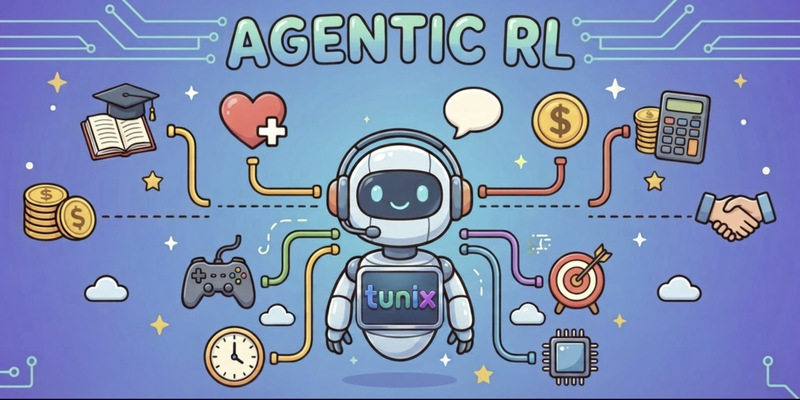
Tunix is Google’s new JAX-native post-training library designed to eliminate TPU idling bottlenecks when training multi-turn, tool-using LLM reasoning agents. It maximizes hardware throughput by combining highly concurrent, asynchronous rollouts with a decoupled producer-consumer pipeline, ensuring the trainer is constantly fed even while agents wait on network I/O or environment steps. Additionally, Tunix provides plug-and-play abstractions and continuous macro-level profiling, allowing developers to easily integrate custom open-source environments and optimize complex distributed workflows without massive code rewrites.
JULY 8, 2026 / Mobile
On May 23, 2026, fresh off the stage at Google I/O, our Google Developer Experts (GDEs) converged on...

JUNE 22, 2026 / Web
AI coding agents are rapidly shifting from reactive assistants that complete tasks when prompted to ...

JUNE 18, 2026 / AI
Celebrating the first anniversary of the Agent-to-Agent (A2A) protocol, this blog post highlights how the framework enables autonomous AI agents to securely collaborate and hand off tasks without the rigidity of traditional APIs. By delegating complex workflows to specialized peer agents, A2A prevents context pollution, ensures data privacy, and simplifies application design through modularity. To demonstrate this ecosystem in action, the post spotlights FoldRun—an agentic interface for life sciences that orchestrates complex protein structure predictions—alongside diverse A2A use cases spanning commerce, data streaming, DevOps, and telecommunications.

MAY 4, 2026 / AI
Researchers at UCSD have successfully implemented DFlash, a block-diffusion speculative decoding method, on Google TPUs to bypass the sequential bottlenecks of traditional autoregressive drafting. By "painting" entire blocks of candidate tokens in a single forward pass rather than predicting them one-by-one, the system achieved average speedups of 3.13x, with peak performance nearly doubling that of existing methods like EAGLE-3. This open-source integration into the vLLM ecosystem optimizes TPU hardware by leveraging "free" parallel verification and high-quality draft predictions for complex reasoning tasks.

APRIL 23, 2026 / Mobile
LiteRT is a production-ready framework designed to help mobile developers unlock the power of Neural Processing Units (NPUs), overcoming the performance and battery limitations of traditional CPU or GPU processing. By providing a unified API that abstracts away hardware complexities, it allows industry leaders like Google Meet and Epic Games to deploy sophisticated AI models for real-time video, animation, and speech recognition with significantly higher efficiency. The platform further supports developers through benchmarking tools and cross-platform compatibility, enabling seamless AI deployment across mobile devices, AI PCs, and industrial IoT hardware.
