4 results
SEPT. 9, 2026 / Mobile
Google has officially released version 1.0 of the Agent Development Kit (ADK) for Kotlin, achieving full feature parity with the Python and Java ADK cores to enable idiomatic, multi-agent AI development. Built on Kotlin Multiplatform (KMP), the framework leverages Kotlin Symbol Processing (KSP) for zero-reflection, type-safe function calling, alongside advanced orchestration capabilities like human-in-the-loop workflows and context compaction. Additionally, the release introduces a robust suite of Android-first extensions, allowing mobile developers to integrate local models via LiteRT-LM, cloud reasoning through Firebase AI, session persistence using Room, and semantic memory powered by AppSearch.

MAY 21, 2026 / Mobile
Google has announced the launch of version 0.1.0 of the Agent Development Kit (ADK) for Kotlin, alongside a specialized ADK library for Android. This open-source framework simplifies the creation of AI agents by managing complex orchestration, session sharing, and error handling across cloud and edge environments. The release supports hybrid orchestration, enabling developers to build multi-agent systems where a cloud-based model can seamlessly offload specific tasks to local, on-device models like Gemini Nano to enhance user privacy.
MARCH 30, 2026 / AI
Google has released version 1.0.0 of the Agent Development Kit (ADK) for Java, introducing powerful new features like Google Maps grounding, built-in URL fetching, and a standardized Agent2Agent protocol for cross-framework collaboration. The update enhances agent control through a new "App" and "Plugin" architecture, which allows for global logging, automated context window management via event compaction, and "Human-in-the-Loop" workflows for action confirmations. Additionally, the release provides robust session and memory services using Google Cloud integrations like Firestore and Vertex AI to manage long-term state and large data artifacts.

SEPT. 16, 2025 / AI
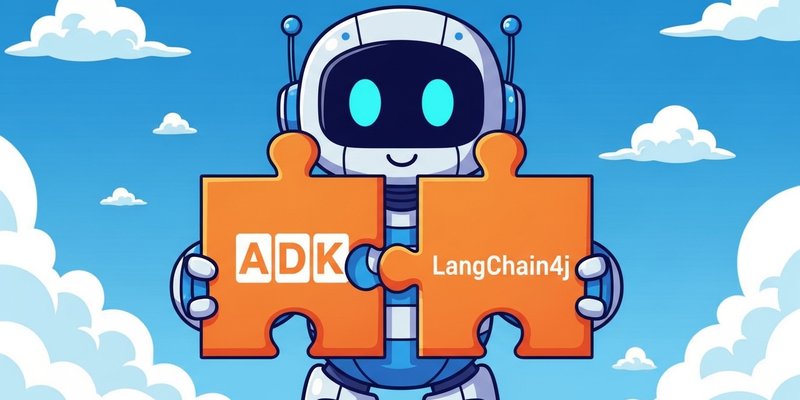
The Agent Development Kit (ADK) for Java 0.2.0 now integrates with LangChain4j, expanding LLM support to include third-party and local models like Gemma and Qwen. This release also enhances tooling with instance-based FunctionTools, improved async support, better loop control, and advanced agent logic with chained callbacks and new memory management.