15 results
AUG. 11, 2026 / Web
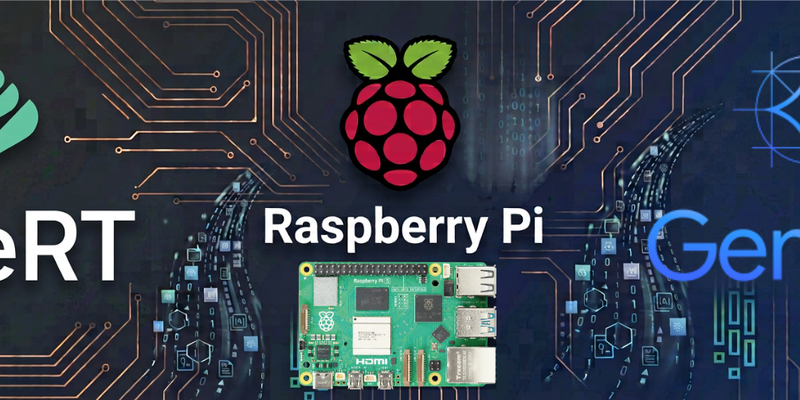
Deploying secure, real-time Edge AI on Raspberry Pi is now simplified using LiteRT and lightweight Gemma open models. LiteRT optimizes CPU and GPU performance, delivering fast token speeds for models like Gemma4, enabling real-time local reasoning for robotics. Developers can quickly convert, quantize, and run these models using the lightweight LiteRT CLI tool. Support for Hailo AI accelerators is also coming very soon.
AUG. 11, 2026 / AI
As AI coding assistants shift the developer's primary role from writing boilerplate to reviewing and maintaining systems, language choice becomes critical for long-term architectural integrity. Go directly addresses this new paradigm by utilizing its strict compiler, integrated toolchain, and uncompromising readability to provide deterministic guardrails that help AI models self-correct and generate highly standardized code. By enforcing ecosystem-wide consistency and strict backward compatibility, the Go platform empowers engineering teams to efficiently verify, optimize, and maintain high-velocity, AI-generated output in production environments.
AUG. 6, 2026 / AI
Agent Plugins 1.0.0 is a new, vendor-neutral directory specification—backed by Google, Amazon, Microsoft, and others—for packaging Agent Skills and MCP servers into a single portable unit. By standardizing the manifest (plugin.json) and utilizing a fixed directory layout, it eliminates the need for developers to maintain separate wrappers or configurations to support different AI coding agents and IDEs. Google has officially joined as a Core Maintainer and already rolled out support in the Agents CLI and Data Agent Kit, allowing developers to start building and distributing interoperable plugins today.

JULY 8, 2026 / Mobile
On May 23, 2026, fresh off the stage at Google I/O, our Google Developer Experts (GDEs) converged on...

JUNE 5, 2026 / AI
Google has announced the Google Colab Command-Line Interface (CLI), a new tool that allows developers and AI agents to connect local terminals to remote Colab runtimes for frictionless execution. The lightweight CLI enables users to easily request high-powered GPUs, run local Python scripts remotely, and seamlessly retrieve artifact logs or models like fine-tuned Gemma 3 adapters. By integrating directly into standard terminal environments, the tool is highly programmable and ready to be used by AI agents such as Antigravity or Claude Code to manage complex machine learning pipelines.

MAY 28, 2026 / Pay
Google has announced the new Google Pay & Wallet Developer MCP server, an open-standard tool designed to securely connect AI development assistants and IDEs with real-time API and account context. The server allows developers to remain within their development environment to search official documentation, validate Wallet pass definitions, check integration status, and manage merchant accounts. Ultimately, this integration aims to reduce friction and accelerate development workflows by minimizing context switching and providing up-to-date, grounded AI support.

MAY 19, 2026 / AI
Google is unifying its AI terminal tools by transitioning the community-focused Gemini CLI into Antigravity CLI, a new agent-first platform built for complex, multi-agent workflows. This new Go-based tool offers faster execution, asynchronous processing, and a unified architecture that syncs with the Antigravity 2.0 desktop application. While enterprise customers will maintain existing access, individual and free users must transition to the new platform before Gemini CLI stops serving requests on June 18, 2026.

MAY 19, 2026 / Cloud
Google announced the transition from assistive AI to independent agents, highlighting the launch of the Gemini 3.5 series and major updates to its Antigravity agent-first development platform. For mobile developers, the post introduces new Android CLI tools, the Android Bench evaluation leaderboard, and an automated Migration agent designed to rapidly convert various frameworks into native Kotlin code. Web development is also being transformed through Chrome DevTools for agents, the HTML-in-Canvas API, and the proposal of WebMCP, an open web standard that enables browser-based AI agents to execute complex tasks.
MARCH 24, 2026 / Mobile
The provided workflow streamlines motion-controlled game development by using Gemini Canvas to rapidly prototype mechanics like the MediaPipe Pose Landmarker through high-level prompting. Developers can refine these prototypes in Google AI Studio by optimizing for low-latency "lite" models and stable tracking points, such as shoulder landmarks, to ensure responsive gameplay. The process concludes by using Gemini Code Assist to refactor experimental code into a modular, production-ready application capable of supporting various multimodal inputs.

MARCH 9, 2026 / Cloud
Wednesday Build Hour is a weekly, interactive "technical gym session" led by Google Cloud experts to help developers and architects sharpen their cloud skills. Moving beyond passive slide decks, the program focuses on hands-on building, covering advanced topics like AI agents, Vertex AI, and developer productivity tools. Each hour-long session is designed to provide tangible results that participants can immediately deploy into their own workflows. It serves as a consistent, dedicated space for builders to stay ahead of the curve and connect with a community of cloud engineers.