
149 results
OCT. 8, 2026 / AI
How do you keep improving an AI agent after the first 80%, once it serves real production traffic and silent quality regressions return HTTP 200 OK? We are open-sourcing AQuA (Ambient Quality Agent), a reference implementation that runs beside your production agent in Google Cloud, sweeps and verifies failure clusters against conversation transcripts, and diagnoses root causes anchored to the exact deployed source snapshot.

OCT. 6, 2026 / Mobile
EmbeddingGemma 2 is a new 740M open-weight multimodal model that maps text, images, video, and audio into a unified vector space for privacy-first, on-device retrieval. Developers can easily integrate these capabilities cross-platform using MediaPipe Tasks or optimize fine-grained performance across CPU, GPU, and NPU accelerators with LiteRT. The model enables ultra-low-latency local solutions like search-as-you-type media retrieval, keyframe video moments finding, and zero-shot intent routing.

SEPT. 24, 2026 / AI
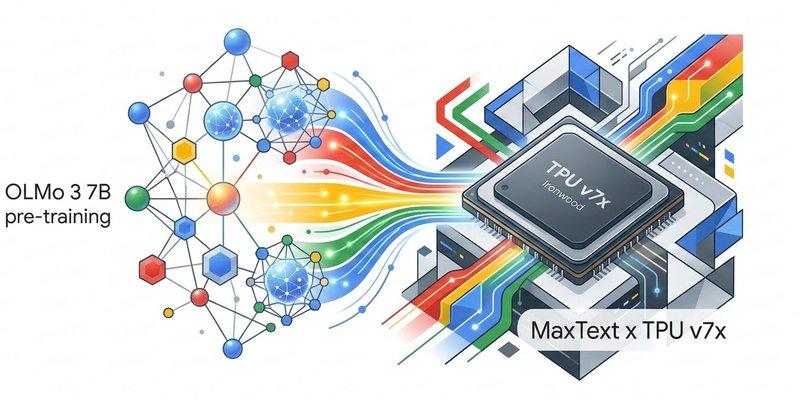
The MaxText team successfully reproduced Ai2’s Olmo 3 7B language model from scratch on Google Cloud TPUs using JAX/XLA, precisely matching the original PyTorch-on-GPU reference across pre-training and mid-training stages on all held-out evaluations. The implementation achieved up to 57.4% Model Flops Utilization (MFU) and demonstrated robust infrastructure portability by surviving mid-run cluster resizes and cross-generation TPU shifts without requiring recipe alterations. Crucially, the exercise proved the necessity of comprehensive held-out validation by catching a silent data-loader memorization bug that artificially depressed training loss and would have otherwise faked a performance win.
SEPT. 11, 2026 / AI
The "autofinetune" project introduces an autonomous research loop that fully automates LLM post-training workflows, including Supervised Fine-Tuning (SFT) and Reinforcement Learning via GRPO. By defining boundary conditions and evaluation metrics in a single Markdown specification, developers can deploy an AI agent to iteratively edit training scripts, launch experiments, and automatically commit verified hyperparameter optimizations to Git. Built on Google’s AI stack—including Tunix, Gemma, and Cloud TPUs—this framework eliminates manual tuning cycles, successfully demonstrating hands-off performance gains in both function calling and math reasoning models.

SEPT. 4, 2026 / AI
The Gemini Enterprise Developer Experience (DevEx) program conducts ongoing sprint testing of end-to-end developer workflows to identify and rapidly resolve friction points without relying on internal shortcuts. This recent sprint focused on optimizing enterprise AI governance, including refining setup prerequisites, securing extension configurations, and clarifying policy enforcement mechanics to ensure a smoother, more reliable deployment. Developers can now leverage updated documentation and standardized code samples to improve their experience with Agent Gateway and Semantic Governance configurations.

AUG. 17, 2026 / AI
Building autonomous AI agents that mutate production state requires moving beyond soft system prompts to a robust zero-trust architecture. To secure Google Agent Development Kit (ADK) workflows against prompt injections and malicious execution, developers must implement hardware-backed cryptographic signatures for database writes, kernel-level sandboxing with gVisor for dynamic code, and deterministic semantic gateways for I/O validation. By enforcing these hard security boundaries at the infrastructure level, you can safely deploy multi-tool AI agents without risking unauthorized data manipulation or server compromise.

AUG. 13, 2026 / Mobile
Credentio is a newly released, open-source C++ library from Google that allows developers to integrate high-performance, local-first validation of C2PA Content Credentials into their client and server applications. By processing assets entirely locally with a highly optimized memory footprint, the library delivers instant validation verdicts for multi-gigabyte media files without incurring cloud latency, bandwidth costs, or data privacy risks. The library currently features deep manifest parsing alongside configurable trust list integration, and is available now on Google Source with future plans to support full credential generation and embedding.

AUG. 11, 2026 / AI
As AI coding assistants shift the developer's primary role from writing boilerplate to reviewing and maintaining systems, language choice becomes critical for long-term architectural integrity. Go directly addresses this new paradigm by utilizing its strict compiler, integrated toolchain, and uncompromising readability to provide deterministic guardrails that help AI models self-correct and generate highly standardized code. By enforcing ecosystem-wide consistency and strict backward compatibility, the Go platform empowers engineering teams to efficiently verify, optimize, and maintain high-velocity, AI-generated output in production environments.

AUG. 11, 2026 / Web
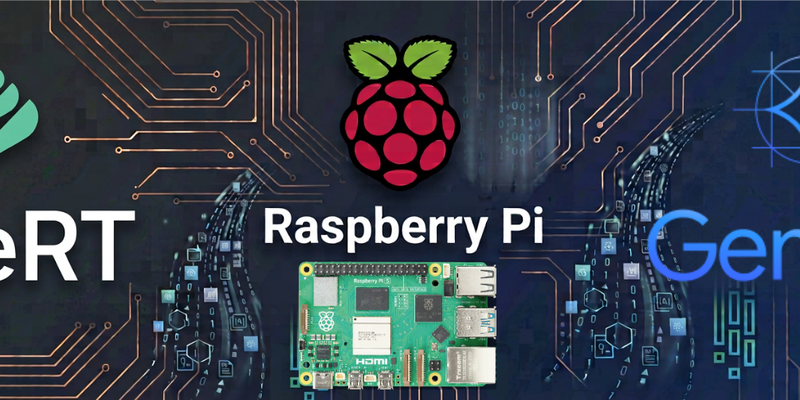
Deploying secure, real-time Edge AI on Raspberry Pi is now simplified using LiteRT and lightweight Gemma open models. LiteRT optimizes CPU and GPU performance, delivering fast token speeds for models like Gemma4, enabling real-time local reasoning for robotics. Developers can quickly convert, quantize, and run these models using the lightweight LiteRT CLI tool. Support for Hailo AI accelerators is also coming very soon.
JULY 31, 2026 / AI
Agent Platform's evaluation service is now generally available, providing developers with a unified engine to measure agent quality consistently across local development experiments and live production traffic. You can evaluate agents using over 20 pre-built metrics, DeepMind-backed adaptive rubrics, or custom code-based and LLM-as-a-judge metrics stored in a centralized, versioned registry. The service integrates directly into existing workflows via the Agent Platform SDK, agents-cli, and ADK, offering built-in user and environment simulators to automate complex multi-turn testing and streamline CI pipelines.
