
43 results
NOV. 11, 2026 / Mobile
A2UI 1.0 is an open protocol for generative UI that enables AI agents to render interactive, native screens across web, mobile, and desktop applications. Developers can leverage open-source renderer SDKs—including React, Angular, Lit, Flutter, SwiftUI, and Jetpack Compose—alongside agent SDKs for Python, TypeScript, and Dart. The release introduces bidirectional function calls, swappable inference formats, and secure data binding to help teams seamlessly integrate generative UI into their product stacks.

OCT. 29, 2026 / Mobile
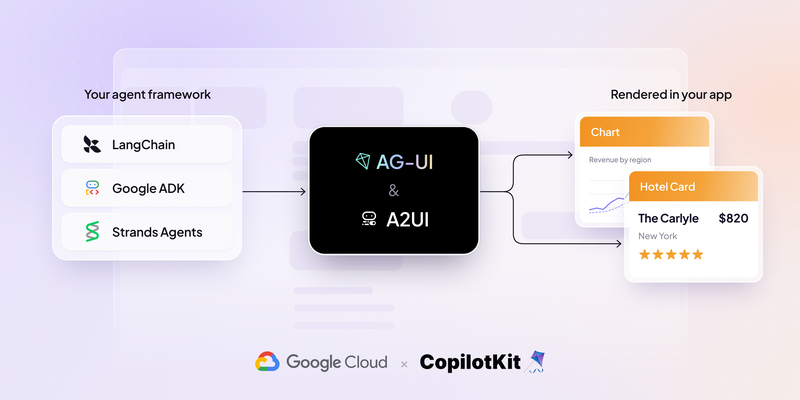
See Google A2Ui in action! Learn how to natively render agentic UIs across Langchain, AWS Strands, Microsoft agents, and Google ADK using CopilotKit SDKs for A2UI.
OCT. 28, 2026 / AI
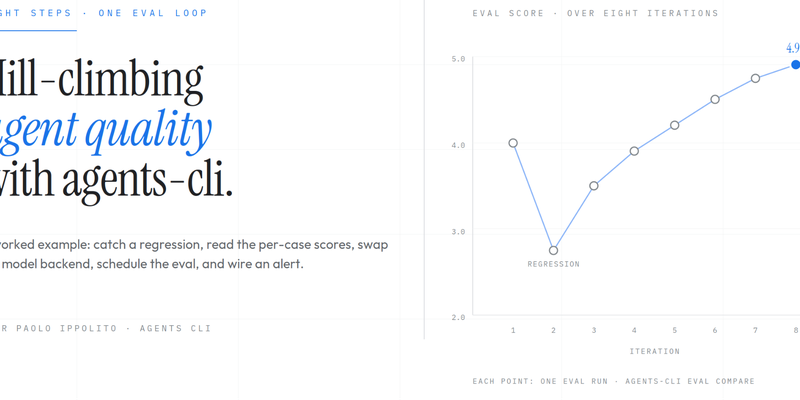
This post walks through the Agents CLI evaluation loop for systematically improving agent performance through continuous testing and grading. It demonstrates how to catch prompt regressions, evaluate model backend swaps using side-by-side trace comparisons, and automate evaluation passes. Developers will also learn how to integrate nightly scheduled runs with threshold-based alerting to track quality over time.
OCT. 27, 2026 / Mobile
A2UI now supports swappable inference formats, introducing A2UI Express which uses up to 3x fewer tokens and cuts latency by compiling compact Python-style syntax into standard A2UI JSON via Agent SDKs. Developers can also use controlled generation with TypeSafe's Jev system-decision models to render known-shape screens in under 300 ms while smaller models stream text. These updates require no changes to frontend renderers or component catalogs, offering flexible performance levers for generative UI development across Python, TypeScript, and Dart.

OCT. 22, 2026 / AI
Learn how Project Chrysalis combines Google Cloud's Gemini Enterprise Agent Platform, Agent Development Kit (ADK), BigQuery, and a four-gate defense-in-depth security stack (Model Armor, Cloud KMS, Binary Authorization, and OPA) to build governed, self-evolving AI agents that remediate live production outages in 1.8 seconds.

OCT. 21, 2026 / AI
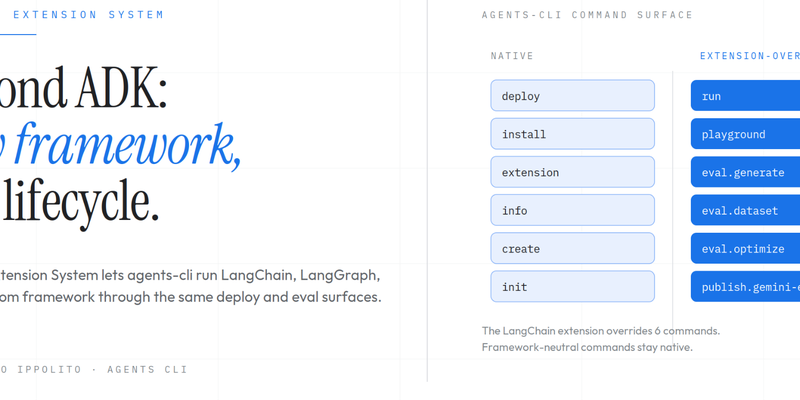
The Agents CLI Extension System enables developers to use frameworks like LangChain, LangGraph, or custom enterprise stacks while retaining a unified deployment and evaluation workflow. It details a first-party LangChain template that scaffolds, runs, and deploys agents without requiring the Agent Development Kit (ADK). Additionally, it demonstrates how platform teams can author custom extensions to enforce policies such as automated software bill of materials (SBOM) scans during deployment.
OCT. 6, 2026 / AI
EmbeddingGemma 2 is a compact, open-source multimodal embedding model that maps text, code, images, video, and audio into a unified 768-dimensional space. Developers can use the sentence-transformers library to selectively load modular modality encoders—ranging from 270M to 740M parameters—to optimize memory usage. Additionally, Matryoshka Representation Learning enables dynamic dimension truncation down to 128d, significantly reducing vector database storage requirements while maintaining high retrieval performance.
SEPT. 30, 2026 / AI
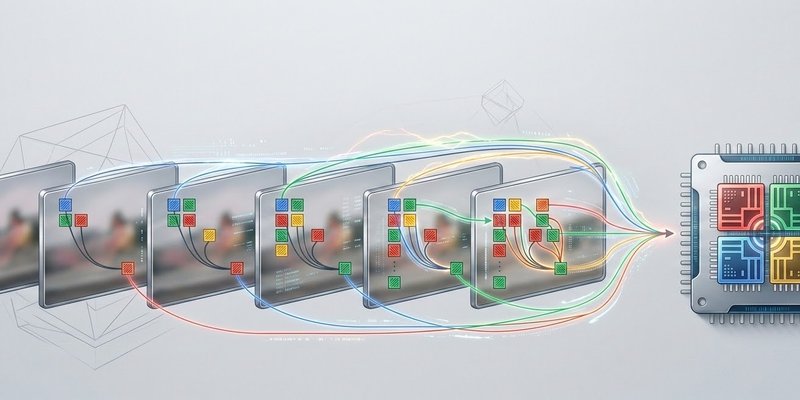
To address the quadratic latency bottleneck of self-attention in high-resolution video diffusion models, developers implemented Sparse VideoGen (SVG) to dynamically route attention heads to highly structured spatial or temporal sparse masks. Translating this algorithmic sparsity into physical hardware speedups on TPUs required optimizing the Splash Attention kernel by bypassing empty memory tiles, restricting exact coordinate masking strictly to boundary tiles, and permuting token memory layouts into temporal-major order for contiguous access. By aligning these sparse masks with actual hardware tile execution, the combined optimizations significantly reduced wasted matrix operations and achieved up to a 1.69x end-to-end inference speedup for 1440p video generation.
JULY 31, 2026 / AI
Agent Platform's evaluation service is now generally available, providing developers with a unified engine to measure agent quality consistently across local development experiments and live production traffic. You can evaluate agents using over 20 pre-built metrics, DeepMind-backed adaptive rubrics, or custom code-based and LLM-as-a-judge metrics stored in a centralized, versioned registry. The service integrates directly into existing workflows via the Agent Platform SDK, agents-cli, and ADK, offering built-in user and environment simulators to automate complex multi-turn testing and streamline CI pipelines.

JULY 31, 2026 / AI
To prevent context window bloat and reduce token consumption, Genkit Go introduces Agent Skills based on a progressive disclosure architecture. Developers can package specialized instructions, scripts, and references into modular SKILL.md bundles where only the frontmatter metadata is initially exposed to the agent's system prompt. When a task matches the skill's description, Genkit's middleware dynamically loads the full instruction body and associated assets, ensuring the model accesses precise workflows exactly when needed.
