
61 results
OCT. 15, 2026 / AI
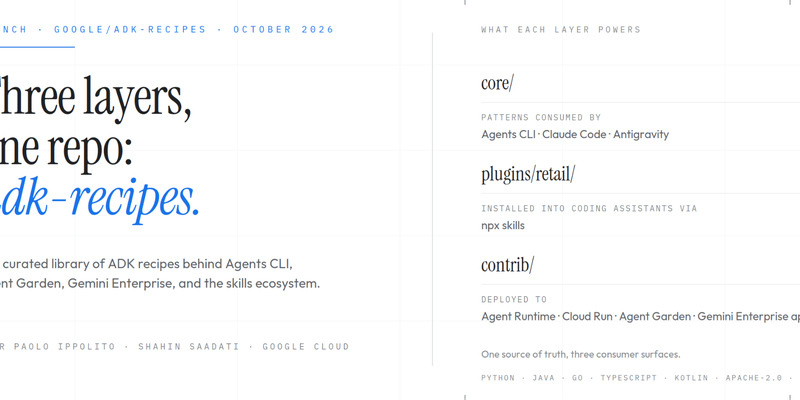
The google/adk-recipes repository unifies Agent Development Kit (ADK) resources into three structured layers—core/, plugins/, and contrib/—serving as a single source of truth for building AI agents. Developers can leverage reference patterns, install modular vertical skills (such as retail product search and virtual try-on) directly into their coding assistants, and deploy production-ready services across multiple languages. This cohesive structure streamlines the entire workflow from initial scaffolding to full deployment on Google Cloud infrastructure.
OCT. 15, 2026 / AI
A practical engineering guide and reference architecture for establishing continuous evaluation pipelines for multi-turn AI agents using Gemini Enterprise Agent Platform, Google ADK, and OpenInference standards.

OCT. 13, 2026 / Gemini
How our engineering team ran Gemini 4 Argon unattended overnight with .agents/skills and /goal mode to cut in-memory session prep overhead by 40% in long sessions and speed up cold imports by 21% in Google's open-source Python Agent Development Kit (ADK).

OCT. 8, 2026 / AI
How do you keep improving an AI agent after the first 80%, once it serves real production traffic and silent quality regressions return HTTP 200 OK? We are open-sourcing AQuA (Ambient Quality Agent), a reference implementation that runs beside your production agent in Google Cloud, sweeps and verifies failure clusters against conversation transcripts, and diagnoses root causes anchored to the exact deployed source snapshot.

SEPT. 23, 2026 / AI
The Google Antigravity SDK now empowers developers to execute offline, agentic workflows locally using models like Gemma 4 26B A4B via LiteRT. This update facilitates powerful hybrid orchestration architectures, allowing a cloud model to act as a lightweight planner while local models securely handle token-intensive tasks—like code auditing and patching—directly on-device. Furthermore, the SDK provides drop-in support for OpenAI-compatible inference servers like Ollama and vLLM, enabling the seamless creation of privacy-first, autonomous local utilities.
SEPT. 17, 2026 / AI
Google has partnered with Speakeasy to open-source their OpenAPI code generation suite under the AGPLv3 license, a strategic move prompted by the sudden shutdown of Google's previous proprietary SDK provider. The newly open-sourced suite equips developers with deterministic, multi-language SDK generators that natively support strict typing and SSE streaming, alongside tools for compiling agent-native CLIs and documentation MCP servers. Engineering teams can now safely integrate this robust tooling directly into their CI pipelines to automatically generate reliable client libraries for their own APIs, all while retaining complete licensing control over the output code.
SEPT. 15, 2026 / AI
This blog post explores how to transition AI agents from static, build-time security controls to dynamic runtime governance using the Gemini Enterprise Agent Platform. It highlights three primary managed defenses: Model Armor for screening edge prompts, Semantic Governance Policies for evaluating tool intent against business rules, and Agent Anomaly Detection for catching multi-turn exploits. By shifting these capabilities to the platform level, security administrators can dynamically enforce policies and neutralize complex attacks without needing to modify or redeploy the agent's underlying code.

SEPT. 11, 2026 / AI
The "autofinetune" project introduces an autonomous research loop that fully automates LLM post-training workflows, including Supervised Fine-Tuning (SFT) and Reinforcement Learning via GRPO. By defining boundary conditions and evaluation metrics in a single Markdown specification, developers can deploy an AI agent to iteratively edit training scripts, launch experiments, and automatically commit verified hyperparameter optimizations to Git. Built on Google’s AI stack—including Tunix, Gemma, and Cloud TPUs—this framework eliminates manual tuning cycles, successfully demonstrating hands-off performance gains in both function calling and math reasoning models.

SEPT. 2, 2026 / AI
The recent Google for Startups AI Agents Challenge revealed that the most successful multi-agent systems rely on foundational software engineering patterns rather than just raw model power. Winning architectures consistently implemented bidirectional MCP for seamless inter-agent communication, async event buses for parallel execution, strict unified validation for model fallbacks, and tiered routing to minimize expensive inference calls. By prioritizing these structural practices over simple linear prompt chains, developers can build more resilient, low-latency, and cost-effective agentic workflows.

AUG. 24, 2026 / AI
Moving live voice agents from demo to production requires rigorous, automated testing to handle the unpredictability of real multi-turn conversations. ADK now provides native live evaluation, allowing developers to test graph-based agent workflows against LLM-driven simulated users that generate actual audio via Gemini TTS. By defining evaluation scenarios and natural-language rubrics, you can automatically score audio responses and tool executions, inspect the resulting transcripts in ADK Web, or run the CLI directly in your CI/CD pipeline.
