88 results
MARCH 24, 2026 / Mobile
The provided workflow streamlines motion-controlled game development by using Gemini Canvas to rapidly prototype mechanics like the MediaPipe Pose Landmarker through high-level prompting. Developers can refine these prototypes in Google AI Studio by optimizing for low-latency "lite" models and stable tracking points, such as shoulder landmarks, to ensure responsive gameplay. The process concludes by using Gemini Code Assist to refactor experimental code into a modular, production-ready application capable of supporting various multimodal inputs.

MARCH 17, 2026 / Cloud
When you’re prototyping locally with AI agents like Gemini CLI, Claude Code, or your own agent, thei...

MARCH 10, 2026 / AI
Google has introduced Finish Changes and Outlines for Gemini Code Assist in IntelliJ and VS Code to reduce developer friction and eliminate the need for long, manual prompting. Finish Changes acts as an AI pair programmer that completes code, implements pseudocode, and applies refactoring patterns by observing your current edits and context. Meanwhile, Outlines improves code comprehension by generating interactive, high-level English summaries interleaved directly within the source code to help engineers navigate and understand complex files.
MARCH 10, 2026 / AI
The Gemini Code Assist team has introduced a suite of updates focused on streamlining the core coding workflow through high-velocity tools like Agent Mode with Auto Approve and Inline Diff Views. These enhancements, along with new features for precise context management and custom commands, aim to transform the AI from a general assistant into a highly tailored, seamless collaborator that adapts to your specific development style.

FEB. 26, 2026 / Mobile
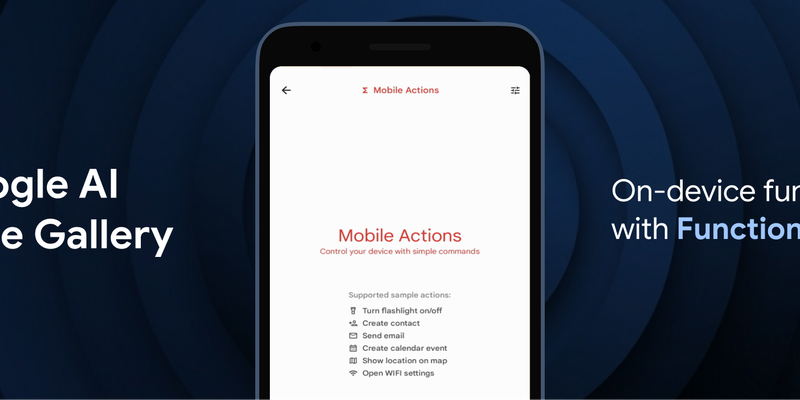
Google has introduced FunctionGemma, a specialized 270M parameter model designed to bring efficient, action-oriented AI experiences directly to mobile devices through on-device function calling. By leveraging Google AI Edge and LiteRT-LM, the model enables complex tasks—such as managing calendars, controlling device hardware, or executing specific game logic in the "Tiny Garden" demo—to be performed entirely offline with high speed and low latency. Available for testing in the Google AI Edge Gallery app on both Android and iOS, FunctionGemma allows developers to move beyond simple text generation toward building responsive, "agentic" applications that interact seamlessly with the physical and digital world without relying on cloud processing.
FEB. 19, 2026 / Gemini
The Android XR team is using Gemini's Canvas feature to make creating immersive extended reality (XR) experiences more accessible. This allows developers to rapidly prototype interactive 3D environments and models on a Samsung Galaxy XR headset using simple creative prompts.

DEC. 17, 2025 / AI
Introducing the Agent Development Kit (ADK) for TypeScript, an open-source framework for building complex, multi-agent AI systems with a code-first approach. Developers can define agent logic in TypeScript, applying traditional software development best practices (version control, testing). ADK offers end-to-end type safety, modularity, and deployment-agnostic functionality, leveraging the familiar TypeScript/JavaScript ecosystem.
DEC. 9, 2025 / AI
Google Cloud enables end-to-end confidential applications, protecting sensitive data 'in-use' with hardware isolation. The solution combines Confidential Space (TEE/attestation), Oak Functions (private sandbox), and Oak Session (attested end-to-end encryption for scale). This framework anchors user trust in open-source components, proving confidentiality for sensitive workloads like proprietary GenAI models, even when running behind untrusted load balancers.
NOV. 7, 2025 / AI
The Agent Development Kit (ADK), an open-source, code-first toolkit for building powerful and sophisticated AI agents, now supports Go. ADK moves LLM orchestration and agent behavior directly into your code, giving you robust debugging, versioning, and deployment freedom. ADK for Go is idiomatic and performant, leveraging Go's strengths, and includes support for over 30+ databases and the Agent-to-Agent (A2A) protocol for collaborative multi-agent systems. Start building today!
NOV. 7, 2025 / AI
The new **User Simulation** feature in the Agent Development Kit (ADK) replaces rigid, brittle manual test scripts with dynamic, LLM-powered conversation generation. Developers define a high-level `conversation_plan`, and the simulator handles the multi-turn interaction to achieve the goal. This dramatically reduces test creation time, builds more resilient tests, and creates a reliable regression suite for AI agents.